
The thick, hardy, water-storing leaves of cabbage are a function of where the plant originated, along the shores of the Mediterranean Sea some 4,000 years ago. The sun-drenched air is salty and makes for difficult growing conditions for any plant. Developing its structure was cabbage’s way to survive and thrive in such a climate and environment.
How humans first started eating cabbage. Learn the history of this hardy, ancient vegetable.
Cabbage was headless at first, resembling what we know as collard greens. During the first century B.C.E., growers of the vegetable selected for one of the cabbage plant’s buds and the hard, smooth, green-white, sometimes red “head” that we know as cabbage was born.
This sort of cabbage ruled the Middle Ages in Northern Europe. Its legacy, in Britain and Ireland, is celebrated today, there and very much in North America, in its annual appearance at the table on St. Patrick’s Day in dishes such as corned beef (or simple beef) and cabbage, or in colcannon — Irish mashed potatoes and cabbage — one of the recipes here.
Varieties of cabbage gain popularity from Chinese cabbages to mini cabbages or Brussels sprouts
But headed cabbage is only one of several sorts of cabbage that figure in cooking. Chinese cabbages, so-called because European cabbage emigrated to the East along the Great Silk Road, are pointed and looser leafed. Bok choy is a good example.
A third sort of cabbage was bred by the Belgians around the year 500 A.D. as Brussels sprouts. These “petits choux,” to use the French term meaning “little cabbages,” are just buds along the thick, fibrous stem of the cabbage.
A fourth variety of cabbage resembles the OG Mediterranean cabbage and is kale and collards, the most commonly eaten vegetable in Britain for more than 1,000 years.
And, finally, a fifth family are “flowering” cabbages such as cauliflower and broccoli. (What we call the “crown” of these vegetables — “broccoli crowns,” for example — is actually the cabbage’s flower.)
Fun facts about cabbage
- Cabbage, Brassica oleracea, is from the family Cruciferae, from the Latin word for “cross.” Cabbage’s flowers are cross-shaped.
- In English, the word cabbage derives from the Latin for “head,” caput, by way of Old French for “head,” caboche.
- For thousands of years, growers have selected various parts of the Brassica plant for various forms of cabbage: selecting for the terminal heads led to hard, smooth “head cabbage”; selecting for lateral buds led to Brussels sprouts; for leaves, led to kale; for the root alone, to kohlrabi; and for stems and flowers, to broccoli and cauliflower.
- Cabbage has been cultivated for more time than any other major vegetable, upwards of 4,000 years.
- Cultivation of the Brussels sprout, on the other hand, dates back only 500 years. It is the youngest member of the cabbage family.
- Cabbage came to the Americas in the 1500s, surging in the 1660s with the influx of German immigrants.
- Many of the ancient Greek and Roman poets and philosophers—Diogenes, Horace, Pythagoras, and Cato, among them—considered eating cabbage a panacea and the secret to a long life. Cato had 25 sons who, he said, “like me, have eaten nothing but cabbage.”
- Cabbage is considered one of the healthiest of foods: it is high in dietary fiber, the vitamins K, C, B6, and A, and sports the minerals calcium, iron, potassium, and manganese. A cup of cabbage is about 15 calories.
- There are over 400 species of cabbage.
- Because cabbages are a very hardy, fertile plant, they gave rise to the myth of “cabbage patch babies,” said to originate in gardens of cabbages.
- Non-starchy vegetables and fruits protect against cancers of the mouth, pharynx, larynx, esophagus, stomach and lung. This includes cabbage.
What are the best ways to cook cabbage?
Broccoli and cauliflower flourish as foods on their own, or dressed in several ways (roasted, braised whole, steamed, boiled, cut into “steaks” and grilled, and so on).
Stuffed cabbage leaves are ubiquitous in the cuisines of Eastern Europe. Cabbage is classically paired with pork in both Western and Eastern cuisines; it is essential to both Chinese and Korean cooking.
Cooking cabbage hence has its rewards, but also its universal downside: its odor upon the application of heat, a function of high concentrations in the raw plant of both mustard oils (which give raw cabbage its “bite”) and various sulfur compounds.
The longer that cabbage is cooked, the more these molecules produce themselves, therefore it is best not to overcook cabbage. For example, the hydrogen sulfide (typical of rotten eggs) produced by cooking cabbage doubles in the fifth through the seventh minute of cooking.
Does red cabbage change color when you cook it?
About cooking red cabbage, keep in mind that any red in it quickly turns to mauve on long cooking, then a slate blue, finally an unappetizing dirty green. However, cooking or preparing red cabbage with an acid (vinegar, for example, or wine, or citrus juice) preserves the red color. That’s the case with the recipe for red cabbage here.
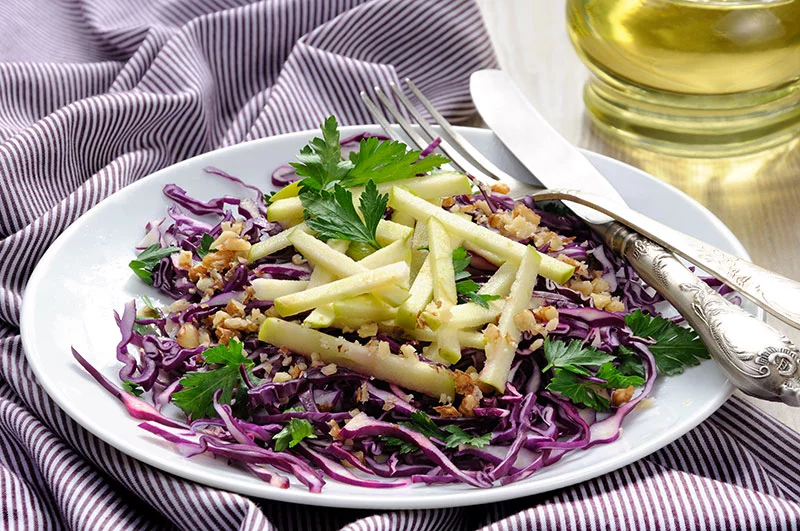
Red Cabbage Salad with Apples
Adapted by Bill St. John from “Everybody Eats Well in Belgium Cookbook,” Ruth Van Waerebeek (Workman Publishing, 1996). Serves 6-8.
Ingredients
- 1 cup cider vinegar
- 2 tablespoons sugar
- 2 bay leaves
- 1 sprig fresh thyme
- ½ head red cabbage (about 1 pound), finely shredded
- 1/2 cup vegetable oil
- Salt and freshly ground pepper, to taste
- 1 tart apple, unpeeled, halved, cored, and thinly sliced
- 1/2 cup walnut halves, toasted (see method below)
Directions
Heat the vinegar with the sugar, bay leaves, and thyme in a small saucepan. Stir until the sugar is dissolved. Pour the warm vinegar and herbs over the shredded cabbage in a bowl and toss well. Cover and refrigerate for at least 6 hours.
Remove the salad from the refrigerator. The cabbage will be wilted and slightly pickled. Add the oil and mix well. Season with salt and pepper. The salad will keep in the refrigerator for 2 weeks.
Just before serving, discard the bay leaves and thyme. Decorate with the apple slices and sprinkle with the walnuts.
To toast nuts:
Preheat the oven to 350 degrees. Spread the nuts out evenly on a baking sheet and bake to 7-10 minutes, until you can just start to smell them and they have started to brown. Keep a careful eye on them as they can scorch easily. Let the nuts cool on paper towels before using.
Colcannon or Irish Mashed Potatoes and Green Cabbage
6-8 servings.
Ingredients
- 4 pounds potatoes, a 50/50 mix of “goldens” or “waxies” and common russets, peeled or partially peeled, as you wish
- 2 sticks unsalted butter, 1 stick at room temperature set aside for the finish
- 1 medium-sized head green cabbage
- 1 cup heavy cream
- Salt and pepper
Directions
Peel, if desired, and cut up the potatoes into same-size chunks. In a large pot, cover the potato pieces with 2 tablespoons salt and cold water and bring to a moderate boil. Cook for 15-20 minutes or until a knife easily pierces a chunk.
When cooked through, drain the potatoes in a colander or, if you can manage it, hold the top of the pot cracked just enough to let the water out. Return or keep the potatoes in the pot, without its cover. Place atop a slow fire (or in a heated oven) and let any residual moisture steam away.
Meanwhile or beforehand, peel off any dark green or wilting leaves from the head of cabbage, core it, and shred the cabbage (as if for coleslaw.) Cook the shreds over medium heat, in a very small amount of water, turning frequently, until the cabbage is cooked through but not mushy. Set aside and keep warm.
In a small pot or pan, mix together the cream and 1 stick of butter and slowly melt the butter, not allowing the liquid to boil or foam.
Stir the cream and butter mix and add about half of it to the potatoes in their pot. Smash away, adding more of the cream and butter mix until the potatoes are smooth and fluffy but still have some lumps within. Fold in the cooked cabbage.
Season to taste with salt and pepper (you may use white pepper). Serve in a large, warmed bowl, the colcannon indented deeply (use a ladle or the back of a large spoon), into which the second stick of butter is melting. As each serving is pulled from the bowl, a bit (well, maybe more) of the melted butter goes along.
Love cooking with cabbage? Try these other recipes that use cabbage.
- Vegetables in escabeche with full-flavored tinned fish
- Grain salad: Bulgur Salad with Carrot, Red Cabbage and Red Apple
- Posole, a comfort soup for flu season
- Barbure des Pyrénées
- St. John’s Congee
- Marleni’s Guatemalan Garnachas
- Classic fermented homemade sauerkraut recipe
- Cabbage Braised with Apples
- Colorado Coleslaw
Bill St. John has written and taught about restaurants, food, cooking and wine for more than 40 years, locally for Rocky Mountain News, The Denver Post and KCNC-TV Channel 4, nationally for Chicago Tribune Newspapers and Wine & Spirits magazine. The Denver native lives in his hometown. Contact Bill at [email protected]