
It was a little after 4:30 p.m. last July on a typical day at Olson Plumbing & Heating in Colorado Springs. Mike Bukowski sat at the desk in his office, wrapping up a quick conversation with the chief financial officer of the company.
As she walked out of his office, a strange sensation started to come over Mike. Just a few seconds later, another colleague walked in. Typically, she wasn’t still at work at this hour, but she had a payroll question for Mike. She noticed that his face looked distorted and strange.
“Are you OK?” she asked Mike.
He knew something was wrong, but he couldn’t speak.
His colleague yelled down the hall for help. Another coworker ran to Mike’s office while the finance officer called 911.
If not for that chance encounter in Mike’s office that afternoon, things almost certainly would have turned out differently. Instead, the smart observations and quick actions from Mike’s coworkers kicked off a series of perfectly timed interventions. It turned out that Mike was having a stroke.
Highly trained nurses, paramedics, EMTs and CT technologists who work in a special ambulance called the Mobile Stroke Treatment Unit, arrived within 30 minutes at Mike’s office and started caring for him immediately. After they gave him a clot-busting drug while still parked at his business, the team whisked him to UCHealth Memorial Hospital Central, which is designated as a Comprehensive Stroke Center where patients receive the highest level of stroke care. Mike not only survived but also recovered fully.
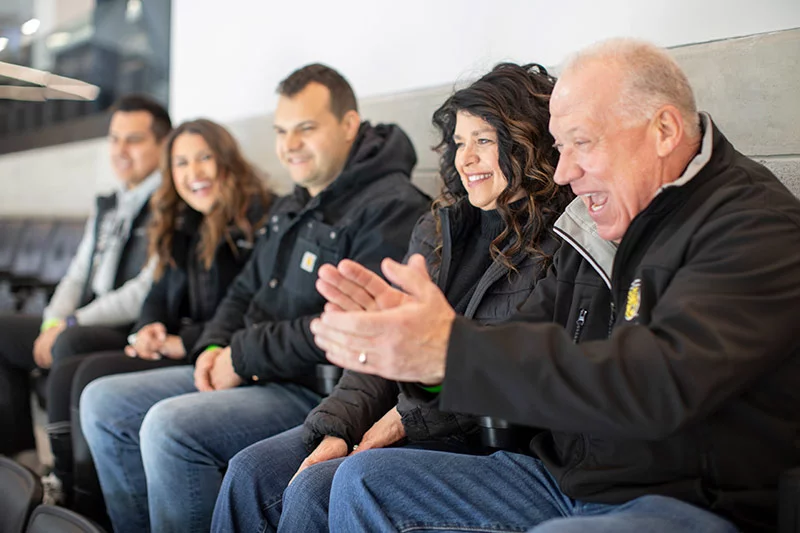
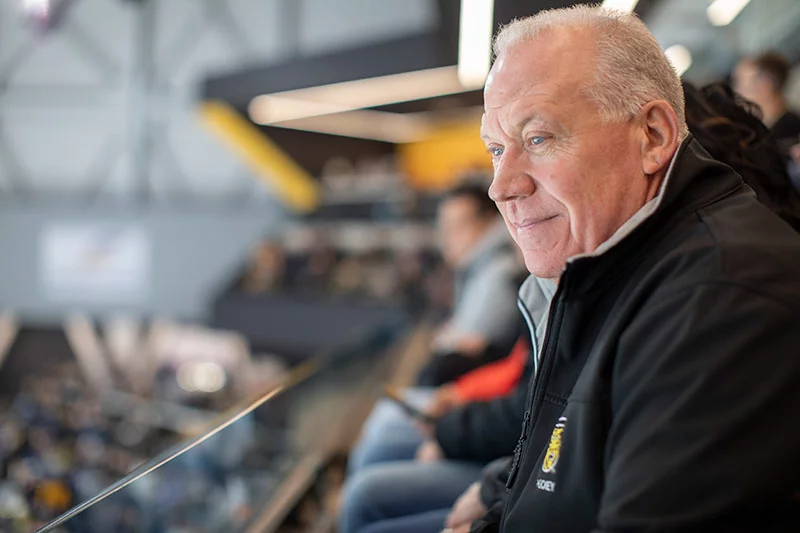
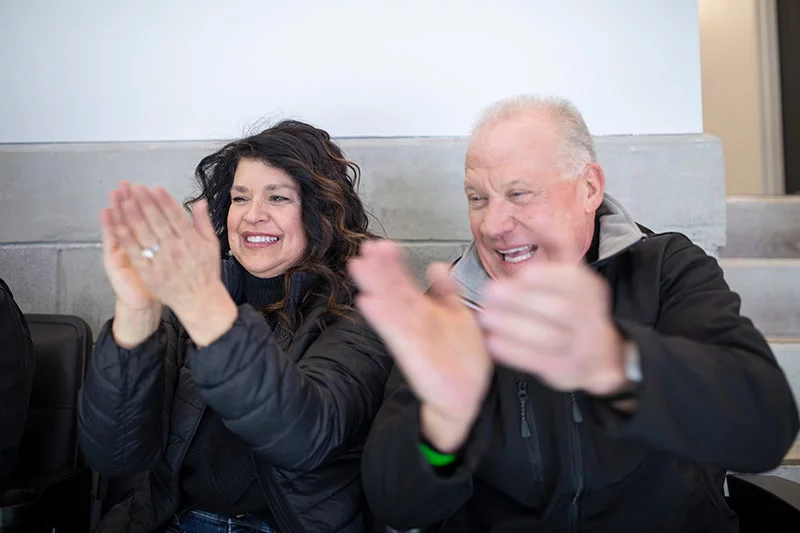
He’s back at work these days as executive vice president at the 109-year-old Colorado Springs company. Mike is part of the fourth generation of his family to run the business. And along with work, he’s once again doing the things he loves with his family, including cheering on the Colorado College men’s hockey team.
“I’m lucky to be here,” Mike said. “The stars lined up, and God is good. I’m a very, very fortunate man.”
A lifetime of fitness, and then the unimaginable — a stroke — happens to local businessman
Olson Plumbing & Heating is among a handful of century-old businesses in Colorado Springs, and its vans are a common sight at large construction sites and local homes, responding to round-the-clock plumbing and heating calls. Work kept him busy, Mike said, and he is accustomed to the pressures of running a large business. Still, by early summer 2025, he felt run down. In addition to his usual financial duties, he was reworking the company’s profit-sharing plan, and the project turned out to be more complicated and time-consuming than he expected. He wasn’t sleeping well, a problem he chalked up to stress over the project.
Mike didn’t consider that he might have a serious health issue. He knew some family members were dealing with heart arrhythmia, meaning your heart can beat too fast, too slow or irregularly. An irregular heartbeat can increase a person’s risk of having a stroke. But Mike had no obvious signs of the condition. He took pride in staying healthy, keeping up with routine screenings like colonoscopies and working out daily in his home gym. His blood pressure was good, and at age 62, he felt fit.
“I’ve done everything in my power to keep healthy,” he said. “Heart trouble never ever even crossed my mind. It came out of nowhere.”
But as Mike sat at his desk that day, he knew he faced a serious problem.
“Something just didn’t feel right,” he said. “And then I couldn’t move.”
Signs of a stroke: ‘Something bad is happening.’
When his colleague asked if he was OK, Mike couldn’t answer. He also couldn’t move his right leg or his right arm. He started to slump over in his chair. He grabbed his right leg with his left hand to keep from sliding out of his desk chair. He worried that he might fall and hit his head on the desk. He tried to steady the cup of coffee he was holding, but it spilled.
“What is going on with me?” he thought. “Something bad is happening, but I don’t know what it is.”
Mike’s colleagues rushed toward him. One of them, who is also his cousin, helped keep him upright by holding onto his shirt collar. After calling 911, Mike’s coworkers also called his wife, Marian and told her they thought Mike was having a stroke.
It was July 15, 2025. Mike calls it “the day that will live in infamy.”
Marian immediately tried to reach their son, Michael Bukowski, Jr. He owns Pikes Peak Forestry and Construction and was working just up the street. He is a trained EMT and a volunteer firefighter with a rural department west of Colorado Springs.
“I called him, and he didn’t answer, and I called again, and he didn’t answer,” Marian said.
Michael was underneath a truck holding a welding torch. When his mom called a third time, he picked up.
“Michael, you need to get to your dad,” she told him.
Next, Marian called their daughter, Mia, who also headed straight to the business.
Michael thought he had heard his mom say that his dad was having a heart attack.
“So, I had my AED (automated external defibrillator), and I was ready to start my cardiac arrest protocol,” he said.
He arrived at his dad’s office within minutes and saw that his dad was conscious.
“He was sitting right there, but he was kind of slumped to the right,” Michael said. “He couldn’t speak, and he couldn’t move any of the right side of his body.”
Michael’s training as an EMT kicked in, and he started taking stock of his father’s condition.
“His pupils were reactive. And then I took his blood pressure, and at that time, he was pretty normal. His pulse was pretty normal. So, I was like, this is good. It’s bad, but it’s good.”
Michael quickly realized that his father was having a stroke. When a stroke starts, quick treatment is critical. There are two types of strokes. Hemorrhagic strokes happen from a brain bleed. Ischemic strokes, the most common, occur when a clot in the brain cuts off vital blood flow and oxygen.
Getting medical treatment right away is critical because every minute after a stroke begins results in the loss of crucial brain function or even death. That’s why Mike lost control of his right side and couldn’t speak.
“You lose millions of brain cells every minute when you’re having a stroke,” said Ashleigh Wright, charge nurse of the mobile stroke unit in Colorado Springs. “You have the best outcomes if you can get treatment within 60 minutes. It’s called the ‘golden hour.’”
The mobile stroke unit, one of only two in Colorado, provides care for patients where they are, inside the specially equipped unit. Wright warns patients and bystanders not to be alarmed when the unit doesn’t speed off to the hospital after loading the patient inside. The point of the mobile unit is to provide on-the-spot treatment as quickly as possible.

For Mike, that meant in the parking lot of his business. The mobile stroke unit team has treated other patients in department store parking lots, fast-food restaurants, patients’ homes and at schools and airports.
Colorado Springs firefighters and an ambulance arrived at Mike’s office a little before 5 p.m. One of them asked Marian if she had a preference about where they took her husband. She told them Memorial Hospital. UCHealth doctors had treated her for breast cancer a few years earlier, and she knew Memorial Hospital is a Level I trauma center. She was confident they could treat whatever was happening with her husband.
Next, at 5 p.m., the mobile stroke unit team rolled up. UCHealth leaders station the team at an administrative center in central Colorado Springs, which was just six miles from Mike’s business.
Wright and her team quickly put Mike on a gurney in the mobile stroke unit and began their assessment, checking how well Mike could move, whether he could talk, how alert he was. They also figured out when Mike’s stroke symptoms started. That’s critical for determining whether someone is a good candidate for drugs that can start to dissolve the clot. Patients need to receive the drug that the stroke unit team carries on board, called tenecteplase, or TNK, within 4 1/2 hours of the onset of symptoms.
Wright and the team knew Mike’s chief financial officer had seen him around 4:30 p.m., and he seemed fine. Then, just seconds later, the other coworker had asked him, “are you OK?”
Mike fell within that window.
In fact, just 30 minutes had elapsed since the start of his stroke.
CT scan inside mobile stroke unit speeds diagnosis and treatment
The mobile stroke unit looks like an ambulance on the outside. On the inside, it’s a complete stroke treatment unit on wheels. A team of experts can immediately provide vital care to stroke patients wherever they are. The unit features state-of-the-art equipment, including a CT imaging unit and a virtual health system that allows the team to communicate with an on-call UCHealth neurologist who can diagnose and recommend treatment before the unit leaves for the hospital. The unit also carries the TNK on board.
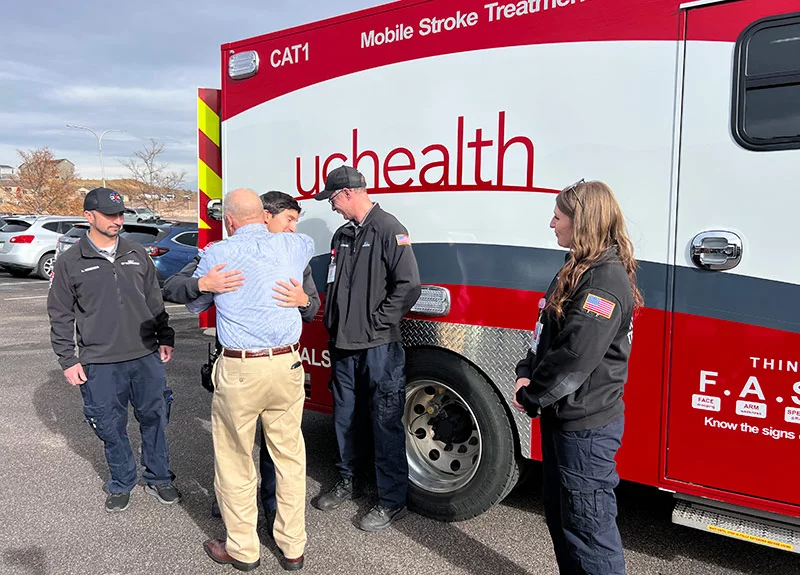
The team took a CT scan of Mike’s brain and sent it through the computer network to an on-call UCHealth neurologist.
At 5:26 p.m., Dr. William Jones, a neurologist with the UCHealth Stroke and Brain Aneurysm Center at the University of Colorado Hospital on the Anschutz Campus, reviewed Mike’s scans. Jones, who is also an associate professor of neurology at the University of Colorado Anschutz School of Medicine, determined that Mike was having an ischemic stroke and ordered treatment with TNK.
Two minutes later, at 5:28 p.m., the team started giving Mike the drug through an IV. Less than an hour had passed since the stroke started.
Mobile stroke unit saves an average of 36 minutes in treatment
The Mobile Stroke Treatment Unit at Memorial Hospital is one of two in Colorado. The other is based at University of Colorado Hospital. They are the only special stroke units in the Rocky Mountain region, and there are only a handful of other mobile stroke units elsewhere in the U.S.
UCHealth leaders launched the first unit in 2016 as part of a national study evaluating whether stroke patients who get treated quickly with a clot-busting drug do better than those who travel by ambulance to the nearest ER. The results were striking. Patients who get treatments in a mobile stroke unit were nearly two-and-a-half times more likely to have better outcomes. They had either no symptoms after the stroke, including difficulties talking or moving, or no significant disabilities despite symptoms. Mobile stroke unit teams cut an average of 36 minutes in getting patients the treatment they need to start opening up blood vessels in the brain.
Importantly, the teams on mobile stroke units (as well as ambulances) deliver patients to appropriate hospital stroke units, not free-standing emergency departments or urgent care clinics. Those facilities are not equipped to treat patients having a stroke.
For eight years, Colorado Springs and University of Colorado Hospital shared one unit, alternating weeks between the two cities. Then, in February 2024, Colorado Springs got its own full-time mobile stroke unit, thanks in large part to donors who contributed more than $750,000 to the Memorial Hospital Foundation to pay for the unit.
In 2025, the Colorado Springs unit responded to 1,095 calls and transported 147 patients to the hospital. In January 2026, calls for service rose 22 percent over January 2025, and the number of patients transported rose 36 percent, Wright said.
She attributes the increase, in part, to a new arrangement with the Falcon Fire Department to help stroke patients in the fast-growing rural area east of Colorado Springs.
Neurosurgeon removes clot from Mike’s brain with a procedure called thrombectomy
Within minutes of giving Mike the TNK, the mobile stroke team headed to Memorial Hospital.
Mike remembers everything about that day – losing feeling on his right side, getting help from his colleagues, and even the ride to the hospital. He spotted familiar landmarks through small windows as he lay on the gurney. The TNK was working fast. Within just a few minutes, he started to feel his right side again.
Mike suffered a large-vessel occlusion, or LVO, stroke. These strokes happen when a clot blocks a major blood vessel before it branches into smaller arteries. LVO strokes account for about 30-40% of ischemic strokes and have the most serious and life-altering symptoms. While intravenous clot-busting medication may open smaller arteries and occasionally larger arteries, the so-called gold standard treatment for these strokes is a procedure called a thrombectomy.
At 5:48 p.m., less than 90 minutes after Mike’s stroke started, the unit arrived at the Memorial Hospital emergency department, where Dr. Ricky Medel was all set to help. He talked with Mike and Marian about the procedure Mike would undergo in the hospital’s catheterization lab.
Medel is a neurosurgeon. His job was to remove the blood clot from Mike’s brain by guiding a catheter through a femoral artery in his leg to the blockage in his brain. Medel then activated a tiny device to grasp and pull out the clot.
Medel successfully removed the clot and finished the procedure within an hour after Mike arrived at the hospital.
“He had a good result,” Medel said.
Marian recalled Medel checking in with her after the procedure, telling her that he was able to remove the clot from Mike’s brain.
“I was like, ‘Oh, he’s going to be fine,’” Marian recalled.
Medel responded with a sobering statistic. He told her that only 25% of stroke patients recover fully if they suffer damage during a stroke.
“I parked the information in the back of my mind,” Marian said, describing herself as a person of faith. “I knew he was going to be one of the ones who comes back.”
Singing a familiar tune can help speech return after a stroke
Mike went to the Intensive Care Unit after the procedure. Dr. Janice Miller, a Memorial Hospital neurologist who oversees the stroke program and cared for Mike, described his stroke as “significant.”
Still, Mike started getting feeling back in his arms and legs, and he could walk a few steps the next day.
He couldn’t yet talk, so he wrote notes to his family.
“I’m going to be 100 percent,” he wrote. “Don’t worry.”
The day after his thrombectomy, Miller tried talking with Mike.
“The words were there. They just wouldn’t come up,” he recalled.
Then, Miller suggested he sing “Happy Birthday.” Doctors sometimes encourage stroke patients who can’t yet talk to try singing because it uses a different part of the brain and can eventually lead to speaking.
The words to the familiar ditty came easily for Mike.
His next word was “Hi.”
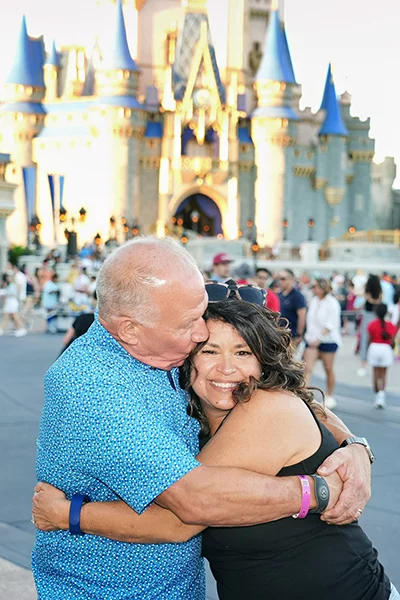
Then, as his ability to talk slowly returned, Mike told his family members that he wanted to plan a trip to Disney World, a place they love.
Mia took videos and photos of her dad nearly every day as his recovery progressed. In fact, she started snapping pictures on her phone when the Mobile Stroke Treatment Unit rolled into the parking lot at work.
“He always has so many questions, and he loves pictures,” Mia said. “I told my mom when we were standing outside with the stroke unit, and I was taking pictures, ‘He’s going to want to see these.’ Then, a couple of weeks later, he asked, ‘Did anyone take any pictures?’”
Recognizing stroke symptoms is crucial
While Mike was in the Intensive Care Unit, Miller determined that he did have a heart arrhythmia that likely contributed to his stroke. Mike had both kinds of abnormal heart rhythms – atrial fibrillation and atrial flutter. Abnormal heart rhythms can cause blood clots to form in the heart, which can then travel to the brain and cause a stroke. Other risk factors for stroke include smoking, high blood pressure, diabetes, blood clotting disorders, poor diet and lack of exercise.
Two million neurons die every minute when a clot blocks blood flow to the brain. Strokes are the fifth-leading cause of death in the United States, and the main cause of permanent disability. That’s why it’s so crucial for family members, coworkers or even strangers to recognize the symptoms of a stroke.Know the signs of a stroke
Wright, the nurse, and Miller urge people of all ages, even those as young as their 20s and 30s, to know the symptoms of a stroke, even if they don’t think they’re at risk. People in these age groups do have strokes, often caused by unknown risk factors, Miller said.
“If they have the symptoms, they shouldn’t say they’re too healthy to have a stroke,” Miller said.
“The sooner that vessel gets open, the better the outcome,” she said. “With any delay in any part of that chain, people will have a worse outcome.”
She notes that for Mike, every step in that chain functioned, starting with coworkers who recognized the signs of his stroke and called 911.
Family fulfills dad’s wish to visit Disney World
To help Mike get his heart rhythm back to normal, doctors performed a procedure called cardioversion, which sends quick, low-energy shocks to the heart. Mike also had two other heart procedures called ablations, which remove or destroy abnormal tissue so the heart can maintain a healthy rhythm.
Since then, Mike has returned to work full-time. And he and his family have returned to enjoying their favorite pastimes together.
In October, they made that trip to Disney World that Mike first mentioned in the hospital, logging 18,000-step days and reveling in his recovery.
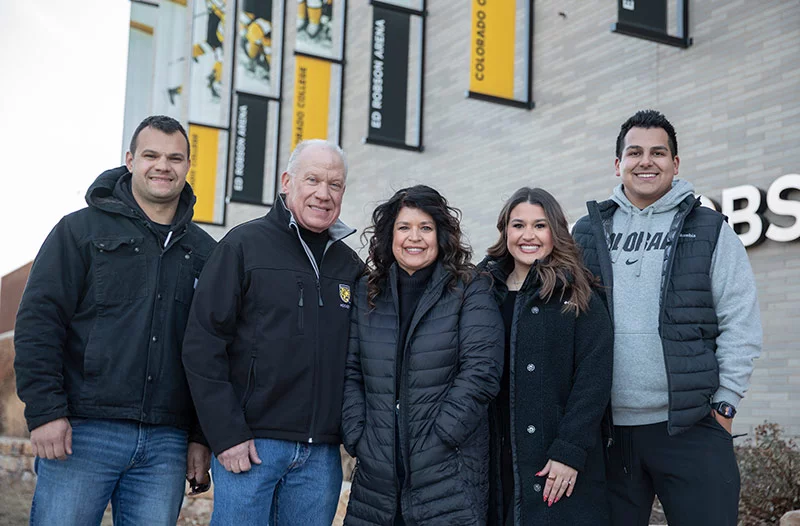
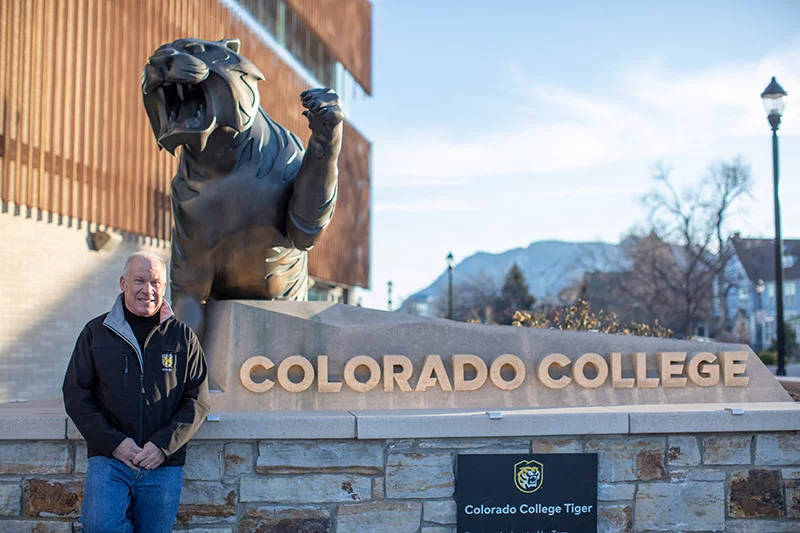
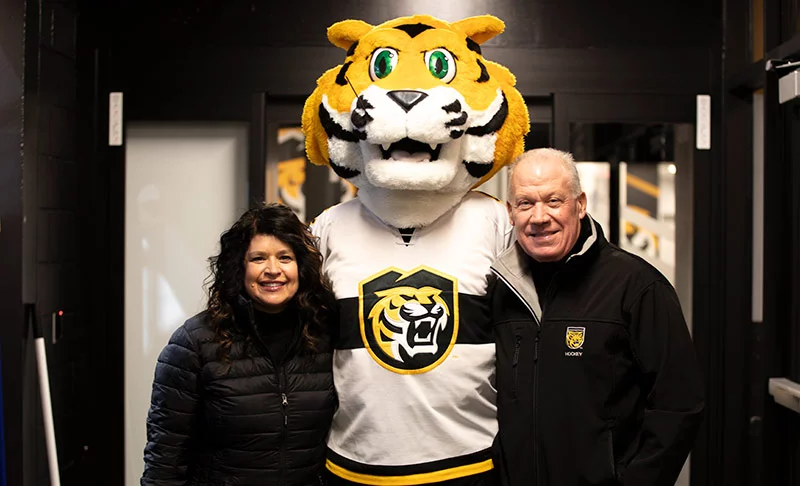
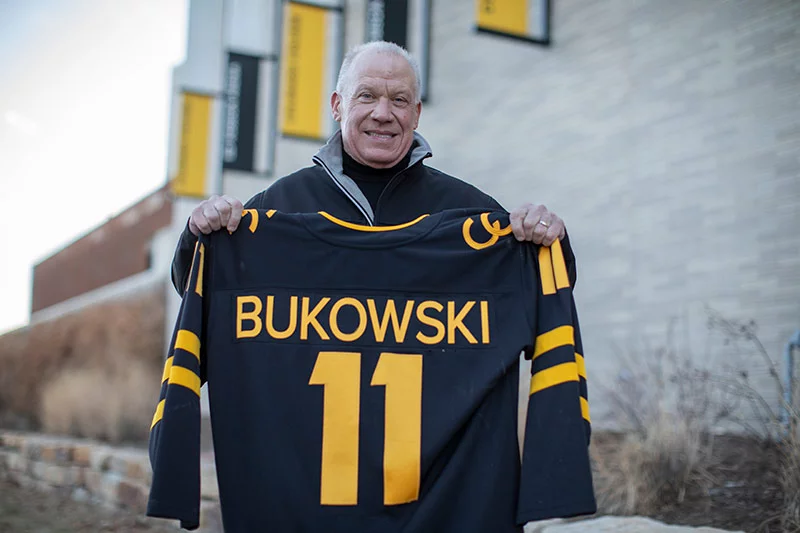
This winter, the Bukowskis attended Colorado College men’s hockey games together. Mike’s company has donated to the CC hockey program since the 1940s. On a recent Saturday evening, Mike, Marian, Michael, Mia and her fiancé, Camden Raedel, cheered on the Tigers in the final home game of the season. After the first period, CC honored Mike and Marian for Olson Plumbing & Heating’s contributions to the CC hockey Power Play program, which in turn donated the money from that game’s Power Play fundraiser to the mobile stroke unit, among other causes.
Sometimes, Mike and his family look at videos and photos of Mike from the first hours and days after the stroke and marvel at how far he’s come. He still works with a speech therapist to practice pronouncing the letter “s.” Otherwise, he has made a full recovery.
“Without the stroke unit, I wouldn’t be here,” Mike said. “We are very lucky for this community to have it. It saved my life.”
Marian never doubted her husband, or her faith.
“I watched Mike get better every day,” she said.
She praises all of the medical experts who saved her husband’s life, including the talented nurses and paramedics who help so many people through the mobile stroke unit.
“We’re just so thankful that we have something like this in Colorado Springs,” Marian said. “His outcome could have been completely different.”