
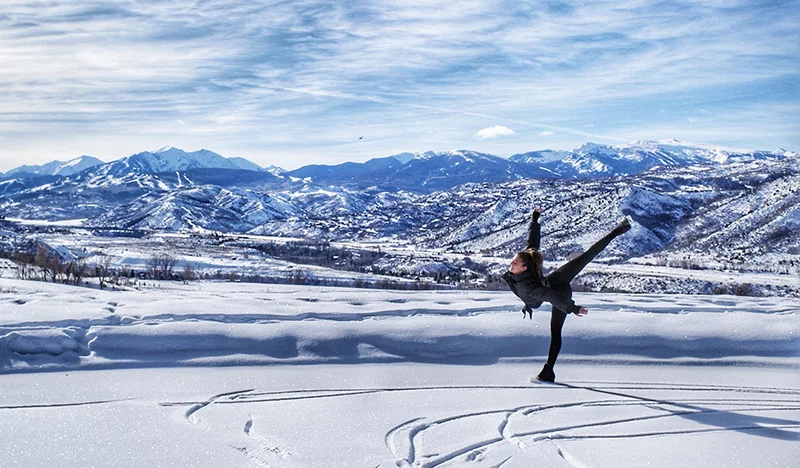
When professional figure skater Sari Behr was touring overseas last spring, her balance, poise and precision were tested like never before. Unlike in the past though, Sari’s nemesis was not the other competitors, finicky judges or the slim sliver of metal on which she accomplishes gravity-defying spins, swirls and jumps.
Instead, Sari, then just 26, was facing something far more serious. And it had the potential to destroy her career, her dreams and her No. 1 passion since childhood. For the first time since she could remember, she had to give up skating.
Before Sari learned what was causing her double vision, headaches and intermittent excruciating pain behind her right eye, she had to travel across the world from Southeast Asia, where she had been performing, and travel back to her home in Colorado to seek answers from experts at UCHealth University of Colorado Hospital.
Sari then had to focus on patience and hope as she waited for answers that would come after multiple scans and tests. Then in August, she endured a surgery called a craniotomy. Doctors removed a brain tumor that was pressing on an eye nerve called the oculomotor nerve. After surgery, Sari faced weeks of uncertainty once again before learning whether she would regain her eyesight fully and recover well enough to once again skate at the optimum level she had trained for her all of her life.
Symptoms that signaled a skull base tumor stopped Sari from skating
Before her surgery, Sari dealt with an array of terrible symptoms.
“It got to the point that it was painful with the pressure behind my right eye. It was excruciating and disorientating. I would have double vision, and it was hard to function day to day,” said Sari, now 27, who grew up in Basalt near Aspen in Colorado’s beautiful Roaring Fork Valley.
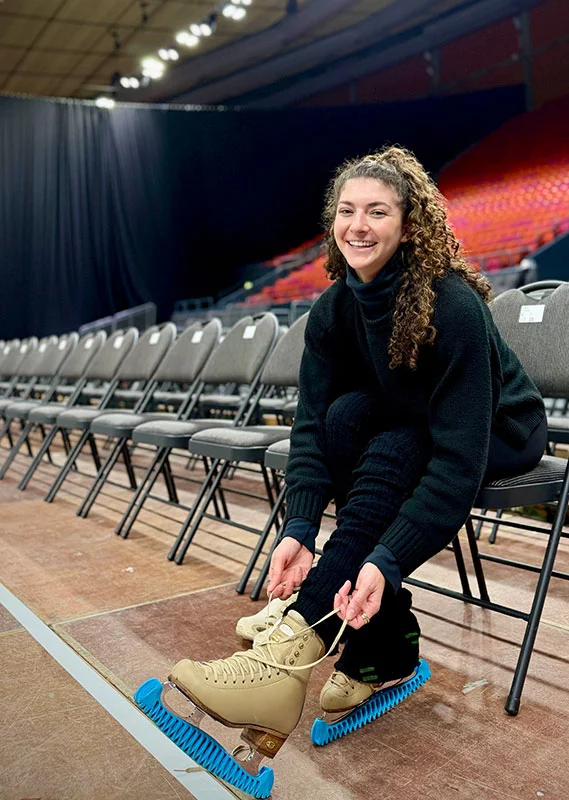
“Skating had been a great outlet and such an important part of my life and identity, and then, ironically, skating was the worst thing I could do with the spinning and rotating. The few times I would try to go and skate, thinking it might make me feel better, I had to lay down I was so nauseous. There were minimal things I could do on ice that wouldn’t trigger these symptoms.”
Accustomed to the nail-biting, high-stakes moments that come with professional skating, Sari and her family soon faced another type of anxiety in a different type of arena – the medical one, where they had to place their faith and trust in UCHealth doctors as they performed a delicate operation with the hope that Sari could someday return to the ice.
“That was one of the hardest pieces of my whole experience – losing access to skating for a while and waiting for the surgery and recovery,” Sari said. “Doctors were hopeful, but there were no guarantees with the brain surgery that my vision would go back to normal. Confronting that reality meant thinking about possibly having to change my career and many other aspects of my life.”
Sari’s early skating life before facing a skull base tumor diagnosis
Sari’s mom, Peggy Behr, was an accomplished figure skater who became a skating coach and began working with Sari when she was a toddler.
“I was always at the rink with my mom when she went to work, and then I started to fall in love with skating and never stopped.”
Sari competed competitively from the age of 4 through high school.
Skating at that level was demanding, as she would practice before and after school, along with keeping up with academics and other sports and activities.
Sari was both graceful and athletic. She studied ballet and competed in soccer, and brought the elegance of dance and the rugged athleticism of soccer to her skating. She also was disciplined, responsible and focused.
“She was always super organized and a really hard worker,” said Sari’s mom, who now teaches Pilates. “She’s just a beautiful skater.”
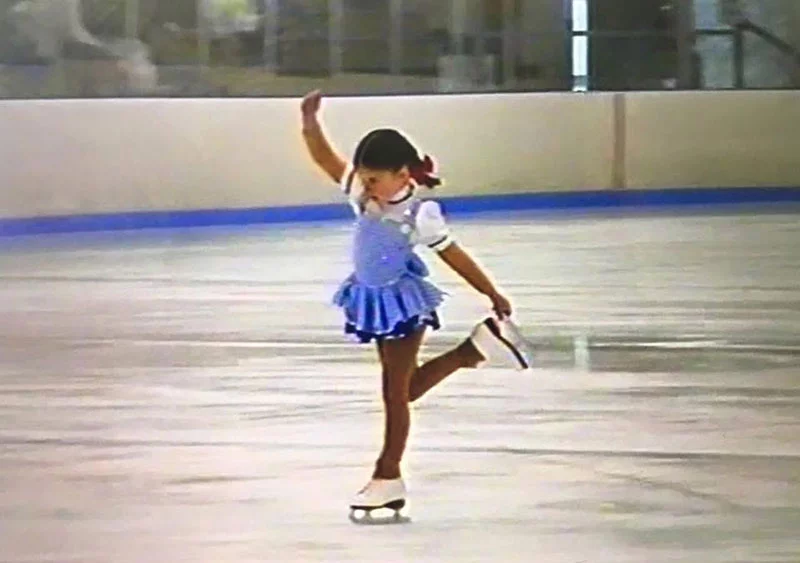
After graduating from Aspen High School in spring 2017, Sari knew she wanted to pursue a career in skating but away from the competitive world.
“I was always a very nervous competitor and found it very stressful,” Sari said.
That’s when she found a perfect new option: performing in shows.
“I fell in love with that, and it spoke to me so much more than the competitive world,” she said.
Peggy Behr had been a skater for “Disney on Ice,” and Sari decided to take a gap year before heading to college and following in her mom’s footsteps. When an opportunity came to try out, Sari threw her hat — and her skates — in the ring, or the rink, in this case. She won a spot in the show and soon joined a touring company, which travels across the U.S. and throughout the world, bringing familiar fairy tales to life on ice.
“It was very exciting, and once I got on tour, I kind of fell in love with this part of the sport. Show skating and performing felt like a whole new world. It’s about the storytelling and the beauty of skating and not just points.”
After one year on the road, Sari decided to take a break and attend college. She crammed a four-year degree at University of Colorado Boulder into three years. She graduated in 2021 with a bachelor’s in psychology, but decided she wanted to go back on tour with Disney, which she did soon after graduation.
Over the past several years, Sari has embraced a life on the road: enjoying the hustle of planes, buses and ice rinks in far-flung places. Since her college graduation, Sari has done five tours that have taken her to Europe, South America, Asia, Africa and much of North America. The crew of 60 skaters and scores of backup crew members move from place to place every week.
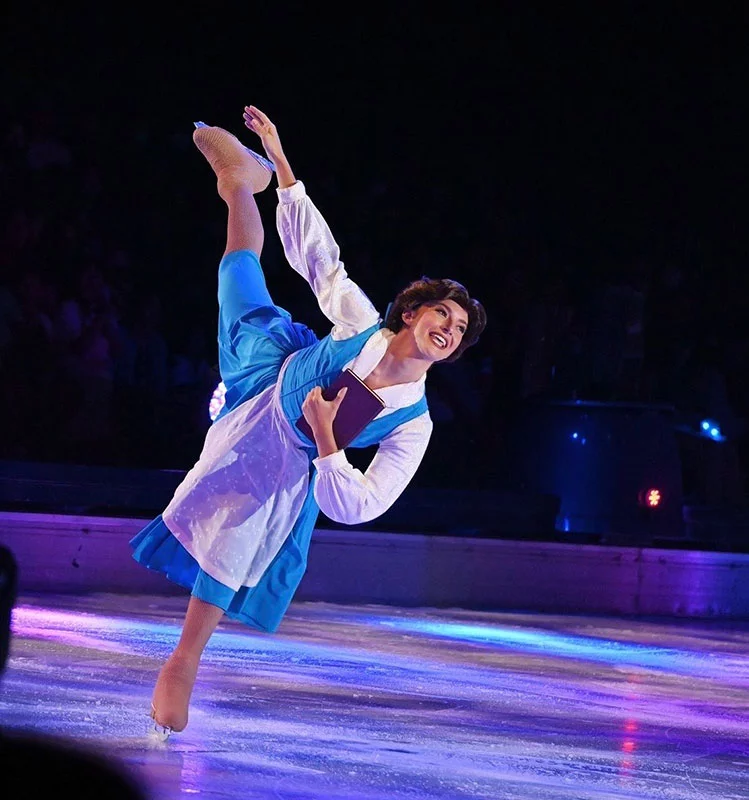
Sari worked her way up to performing her dream role as Belle – the plucky, book-loving princess from “Beauty and the Beast.”
“I always felt like the character, and my skating style just clicked, and it felt natural to play her,” Sari said. “I love that she has a mind of her own and that she prioritizes her family. She believes there is so ‘much more than this provincial life,’ and more out there for her than the small town where she is from.
“I love my small town and love going home to Basalt…but there is so much out there to explore.”
Blurry vision abroad: the first signs of Sari’s rare brain tumor
Last April, while Sari was taking a vacation in Vietnam, she began to have blurry vision in her right eye. A doctor there told her that her pupil was dilated, so she decided to see another doctor in Jakarta, Indonesia, when she returned to the tour. By this time, her eye had been dilated for about a month, and she was told again that her pupil was not responding to light and that the condition might be linked to a neurological problem.
An MRI overseas in May didn’t show anything alarming, but Sari was frustrated that her symptoms were getting worse. She had frequent headaches and light sensitivity, which was hard to avoid as she routinely performed under large spotlights.
“It was bothering me, but it was manageable. My distance vision was alright, and I trusted my muscle memory while I skated, even though things were blurry. But then the double vision began to happen, and I knew something was really wrong.”
Sari left Egypt in June and journeyed back to the U.S. to take some time off. In a Basalt medical clinic, a second MRI hinted at the possibility of a benign tumor, or adenoma, on her pituitary gland as the reason for her vision problems.
Doctors in Basalt referred Sari to experts at University of Colorado Hospital.
As she waited to see doctors there, she tried not to worry.
Escalating symptoms lead doctors to identify a rare skull base tumor
By the end of the month, Sari’s symptoms became so severe that she had to head into the UCHealth ER.
After a series of tests, doctors weren’t so sure she had a pituitary adenoma. Instead, they suspected a rare type of skull base tumor that was pressing on her cranial nerves. The cranial nerves encompass 12 paired nerves that control body functions such as sight, hearing, taste and smell.
There was some good news. Doctors thought her tumor was benign — even though it was in a very delicate place.
Sari soon found herself in the very capable surgical hands of Dr. Samy Youssef, a brain surgeon who specializes in cranial nerve and skull base surgery. He became the point person who led Sari’s care team.
“When he came into the room to talk to us, he said he was very comfortable doing this type of surgery because this part of the brain was his ‘living room,’’’ Sari said. “There were so many unknowns and uncertainties, and he was very comforting. I put my trust in him right away.”
Youssef said that Sari’s pea-sized tumor was in a tight space wedged between her right eye and the cavernous sinus on the specific nerves that control some eye functions. Specifically, it was sitting directly on cranial nerve no. 3, the oculomotor nerve that controls eye movement and pupil constriction.
“To call it a ‘skull base tumor’ doesn’t do justice or explain the intricacy of the surgery needed to remove it,” said Youssef, who is also a professor of neurosurgery and director of the skull base surgery center at the University of Colorado Anschutz School of Medicine. “The difficulty of this was that the tumor was in a very critical space. There is very little room in there to maneuver, and you must be very, very precise.”
Even though the tumor was benign, its location was vexing and would require incredibly meticulous surgery to extract it. In the past, someone with this type of tumor would have to suffer the rest of their life from double vision, or eventually, partial loss or even total loss of vision if the tumor grew.
In Sari’s case, there were a couple of ways Youssef could perform the operation to remove the tumor: through the nose, but that carried a danger of potentially inflaming the nerves; or a cranial approach, where he would reach the tumor through Sari’s skull.
While she tried to keep busy for several weeks in Basalt before the Aug. 5th surgery, Sari took anti-nausea medications, wore eye patches and sunglasses, and was grateful to have some downtime in the mountains.
“I waited for over a month until the day of the brain surgery. I felt like I was in good hands with Dr. Youssef and UCHealth, and was trying to manifest a good outcome, but that in-between period of uncertainty … it was a long time to sit with ‘what ifs.’ I was hoping for the best, but there was also a reality check that my vision might not be the same or could be even worse.”
Sari undergoes a long operation to remove a skull base tumor pressing against her ocular nerve
Youssef determined that the best chance for successfully removing the tumor would be a craniotomy, where a portion of the skull is removed to reach the brain. First, he shaved behind Sari’s hairline where the incision would be, from the top of her head down to her right ear. He did this behind her hairline, so the scar is hardly visible.
Using microscopic surgery, he went behind Sari’s hairline to the top of her eye socket and opened the canal, or the sheath, of the third nerve. With incredible precision, he cut the tumor out without touching the nerve.
“I was very nervous as you’re putting all your trust in other people, but I knew I was in good hands,” Sari said.
After a four-hour surgery, Sari woke up in the ICU. She had been warned that her vision would likely be worse before it got better so she tried not to panic. When she looked in the mirror it was like viewing the world through a kaleidoscope, with the world fractured and fragmented into hundreds of prism pieces.
This was alarming but normal.
“The nature of this cranial nerve is very sensitive and when compressed by a tumor, it can take six months to a year to recover,” Youssef said.
After three nights in the hospital, Sari returned to Basalt, hoping her vision would return to normal and that she could get back on the ice.
Recovering from skull base tumor surgery and returning to the ice
For the next two weeks, Sari recovered, rested and took slow walks while wearing an eye patch. She refrained from bending over to avoid putting pressure on her eye and tried to keep her heart rate down.
A month into her recuperation, she stepped up her daily exercise routine, and at the six-week mark, she headed to the Lewis Ice Arena in Aspen and laced up her skates. She was nervous, scared, but also excited.
“It was very emotional….my vision was a little off, so I couldn’t do much, but it felt so good to glide around and feel the ice again.”
Over the next few weeks, her double vision disappeared, although her pupil remains dilated, leaving her with slightly blurry vision. She is giving herself six months or so until she tries glasses and will return to UCHealth in the spring for follow-up.
“My vision might always be a little off, but it’s so much more livable. I have no headaches or light sensitivity. I know my eyes are still retraining themselves to adjust and recalibrate.
“I am incredibly grateful for Dr. Yossef, my entire medical team at UCHealth, and the amazing community around me – my mom, my family, friends, Cory and coworkers. They have been with me every step of this journey and I wouldn’t have been able to get back on the ice and do what I love without their unwavering support.”
Life after her tumor surgery: Sari returns as Belle in Disney on Ice
Those who know and work with Sari credit her discipline and mental toughness as attributes that carried her through her hardest moments.
“During her ordeal, she never approached recovery passively. She was determined to be back on the ice for this current tour. She listens carefully, follows instructions to the letter and stays focused on any goals she sets for herself. This whole experience was no exception. In fact, I feel she dug deeper with more determination than ever to return to the ice,” said Cory Obst, her Disney on Ice performance director.
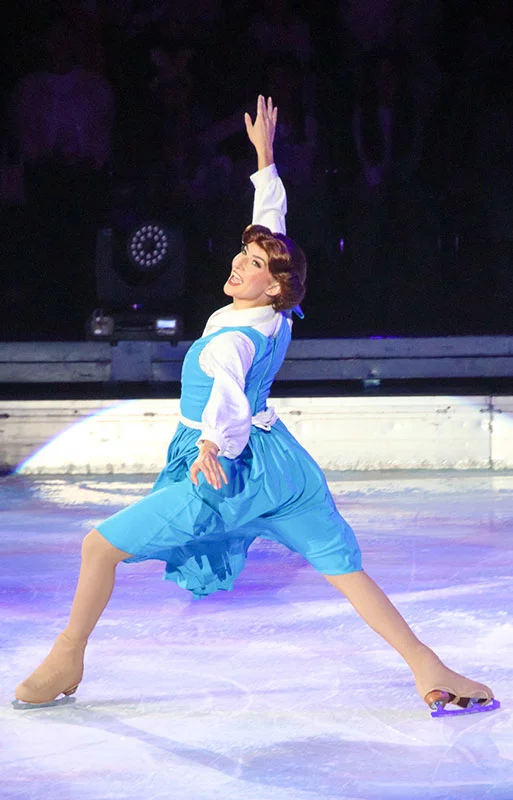
“It’s hard not to lose confidence throughout something like this, but her vast experience as a competitive skater and professional performer served her very well. This all helped her to rebuild her mind and body patiently and safely to get back to her performing levels.”
In the beginning of October, Sari flew to England to return to the Disney on Ice tour. While a little concerned about whether it was too soon, she got the approval from her medical team and became Belle once again.
“It was challenging, but I was OK. Physically, it was harder than I thought, rebuilding muscle and endurance and doing all the same skills I was doing before. I had some mental blocks and was worried about falling and hitting my head, but I worked with Cory, who is amazing, and he helped me find my way back, taking it step by step.”
Sari focused on foundational aspects and technique strength, as she allowed her skating to come back over time and gradually mastered the more challenging elements of her role.
“This mindset not only helped her recover physically but also made her stronger overall as a person and performer,” he said.
Her mom agreed: “She attacked her recovery just like she did the tumor itself, with confidence and paying attention to her body. I am so proud of her.”
Touring is demanding: the cast performs eight shows a week, sometimes three a day, four days in a row, but Sari said she has a new appreciation for skating after she faced the possibility of it being taken away.
“I thought I wouldn’t get to do this again, so every time I’m out there in front of these amazing audiences, I feel so lucky. I’ve always been grateful for this job, but after having lost it for a bit, I feel like it’s a gift now.”
For Youssef, knowing that Sari is back to skating is affirming.
“We do brain surgery every day and are very comfortable with it, and we try to transfer that confidence to our patients,” he said. “Sari’s job relied on her vision and her special abilities, and we are so happy she returned to skating. She was very mature.”
Cory said Sari’s attributes make her the perfect Belle, as she exudes the same traits the Disney character she plays is known for.
“I think audiences connect to her because she delivers a genuine and believable performance.
This is an iconic role of a strong, independent young lady – just as Sari is in real life,” he said.
The happiness Sari feels skating again includes being able to see how children react to her character.
“There are so many little Belles in the audience, and it’s so sweet to see them. It gives me the most incredible feeling. Bringing these classic Disney stories to life and sharing that joy with families around the world means so much to me. I’m skating with a new sense of gratitude.”