
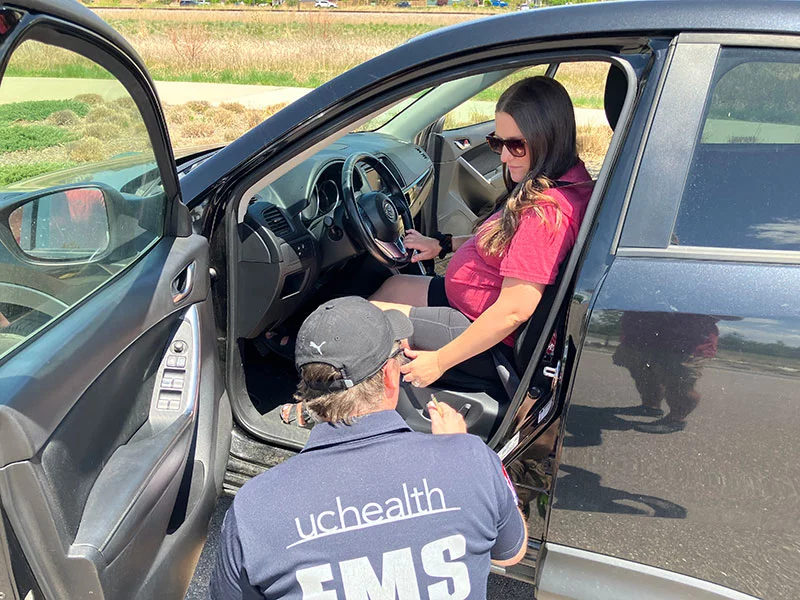
Seatbelts are worn correctly only 12% of the time by those who are pregnant, but UCHealth Emergency Medical Services is on a mission to change that.
“Buckling up is so automatic that we often don’t think about how we are buckling up. Is the shoulder strap in the right spot? Is the steering wheel at the right angle? It is trickier than you think,” said Gregory Colton, an emergency medical technician and community outreach captain for UCHealth EMS.
It makes a difference, he said.
Staying safe: Seatbelts and pregnancy
Between 2006 and 2021, the number of prenatal fatalities in Colorado from motor vehicle crashes reached 1,293 – 17 times more than that of any other age group between 0-13, according to the National Highway Traffic Safety Administration.
“We want the number of prenatal fatalities to go down,” Colton said. “Simple proper seat belt use could cut that number in half and result in fewer fatalities and fewer NICU (neonatal intensive care unit) visits.”
Since January 2021, UCHealth EMS has conducted about 3,550 free seat belt checks for pregnant people in Larimer and Weld counties. And their research shows that in-person educational checks are more effective than providing only take-home seat belt safety materials. Eighty-six percent of expecting mothers continued to wear their seat belts properly after participating in the EMS seat belt check.
Alex Cruise was 36 weeks pregnant with her first child when she took a few minutes on a weekday afternoon in late 2023 to pull into the ambulance bay at the UCHealth EMS station off Riverside Avenue in Fort Collins.

“We had no idea what we were doing, so we thought this would be a good place to start,” Cruise said about the prenatal education opportunities provided by UCHealth EMS.
Cruise got a seat belt check after learning about it during a “CPR training and car seat help” class she and her husband attended. It is also offered free through UCHealth EMS.
Alex agreed to return for a follow-up check as part of the study to determine which methods worked best to improve how pregnant women wear seat belts: informational materials only, in-person seat belt education, a prenatal seat belt check, or no education at all.

UCHealth EMS has since been collecting that data, and what it has shown is that 14% of pregnant drivers who are only handed seatbelt safety materials wear their seat belts correctly. That number increases to 50% when the pregnant driver receives in-person seat belt education from their health care provider, and 86% of drivers who participate in a prenatal seat belt check continue to wear seat belts correctly.
Data also show that among people who have a first check and return for another check during a subsequent pregnancy, 75% are still wearing their seatbelt correctly.
A seat belt check only takes a few minutes. After a driver pulls into the ambulance bay, Colton observes how the driver is positioned and wears the seat belt. Then he helps the driver make any adjustments, such as lowering the chest strap so that it goes across the chest properly or adjusting the steering wheel height so that a deployed airbag will strike the driver in the chest and not at the neck or face, which can result in serious spinal injuries, he said.
“The biggest mistake we see is not having the lap belt in the correct place,” Colton said. “Even adults who are not pregnant wear it incorrectly.”
A person should position the lap belt across their legs to rest on the supportive bones of the hips and pelvis. Doing so can be difficult for pregnant people because of the protruding belly. Colton offers a tip: grab the center of the lap belt and flip the front half over, allowing the belt to rest between the thighs and belly.
“Pregnant and unborn vehicle occupants are the most vulnerable and often overlooked population in traffic safety. The Prenatal Vehicle Safety Educator program brings proven strategies to increase child passenger safety for this vulnerable population,” Colton said.
Wearing a seat belt while pregnant
The goal, he said, with both the lap belt and the shoulder belt is to have them positioned so they won’t move to a new position if the belt’s tension device is activated. The shoulder strap for a pregnant mother must be positioned snugly across the center of the shoulder and chest, between the breasts. It should never go across or on top of the belly.
The same advice applies when a pregnant individual is a passenger.
UCHealth EMS worked with National Child Passenger Safety Certification, a program of Safe Kids Worldwide, to create a Prenatal Vehicle Safety Educator endorsement for child passenger safety technicians. The new certification expands the efforts to educate more pregnant people about safe seat belt use, and as of early 2026, nearly 1,100 child passenger safety technicians, from around the U.S. and from several other countries, have taken the course.
Drivers should also have at least 10 inches between their chest and the airbag. Doing so can be more difficult as the belly grows during pregnancy. However, safety experts recommended this because of the space needed for an airbag to deploy correctly.
Colton is taking the safety checks as an opportunity to gather more information that’s not well known, such as how far a pregnant person’s belly is away from the steering wheel.
“There is a lot of confusion around airbags for pregnant drivers,” he said. “Part of it is that no one has a clear idea of the amount of space there should be between a steering wheel and a pregnant belly. We are taking measurements to establish a baseline and see how far drivers are sitting from the wheel now and what factors affect that distance.”
The UCHealth EMS studies and their prenatal seat belt safety checks are ongoing. People wanting to know if they’re wearing their seat belts correctly can call Gregory Colton at 970.286.1857 to set up an appointment.
UCHealth EMS also offers free infant CPR classes and helps participants properly install their child’s car seat in their vehicles. People interested in that class should sign up at https://www.surveymonkey.com/r/carseatcprcontact. Colton recommends (but it is not required) that people take the course around 34 weeks of gestation and set up their appointments at about 28 weeks of gestation to ensure a spot in the class.
Cruise said that as a new mother, these classes were helpful.
“It was nice having the hands-on demonstrations, experience for the CPR component, and the peace of mind that comes from having an expert check our car seat installation,” she said.