
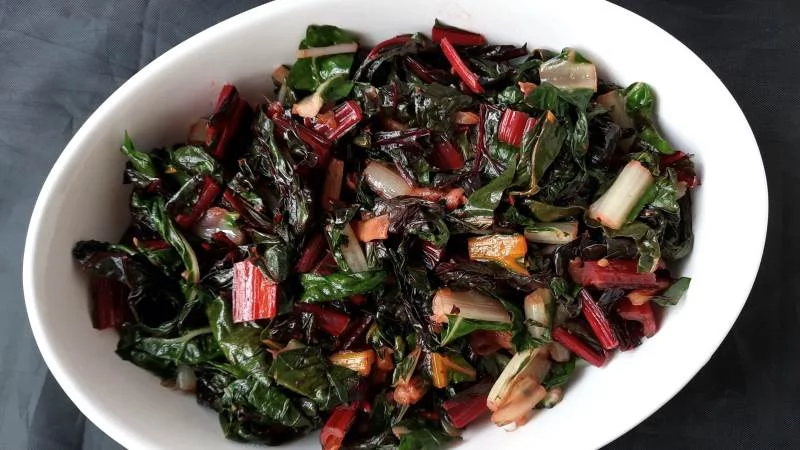
Valentine’s Day is soon upon us, couples and solos alike. Here’s to a “heart-healthy” vegetable — Swiss chard — that, in one of its varieties, comes in the color red, all the more so for your valentine.
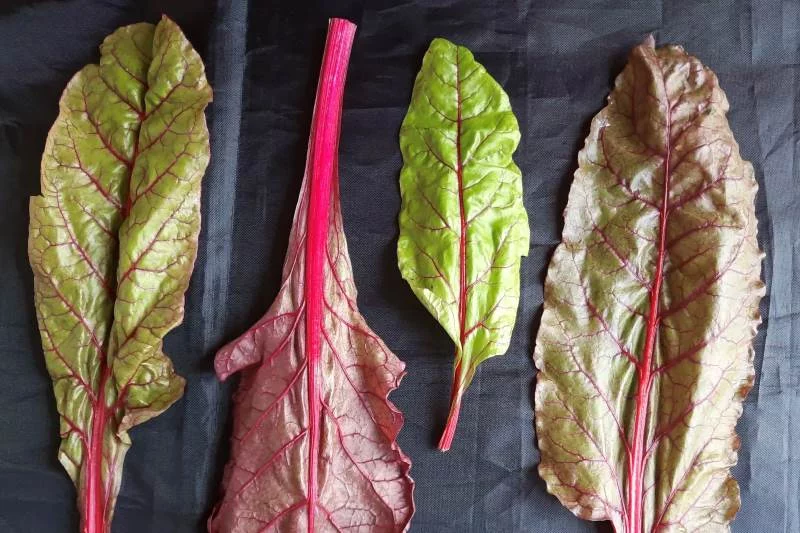
No one is quite sure why this leafy green is called “Swiss” chard, mainly by English speakers. Other languages and peoples call it merely “chard” or prefix that word with one of its colors. We Americans invented the “rainbow chard” label for the array of pink, magenta, orange and off-yellow that chard can sport in the produce section.
The story behind Swiss chard and its not-so-Swiss name
For white chard, the most widely grown and oldest variety, the British often use a more precise color — celadon — a sort of jade-tinged ivory.
The “Swiss” part of the name is odd because chard’s scientific Latin name is Beta vulgaris var. cicla, this last word a probable reference to Sicily, for chard originated in the Mediterranean Basin and remains very popular as an eating vegetable in southern France, throughout Italy and on the Mediterranean Sea’s many islands. The Balearic Islanders make a pocket from its leaves filled with pine nuts and raisins, then steam it, a clear throwback to the region’s Arabian influence.
As its Latin name suggests, it is a member of the beet family, though, unlike the beet, chard forms no edible root. We eat only its magnificent leaves and sturdy stems (which sometimes reach two feet in length), considered by ancient Mediterraneans as a substitute for celery.
Because the ancient Latin and old French word for chard meant “thistle,” one scholar believes that the prefix “Swiss” was used to distinguish chard unmistakably from thistle, a much gnarlier and not easily approached, well, weed. (An edible version of thistle is grown and called “cardoon.”) But again, why “Swiss,” no one appears to know or by whom.
How to prepare and cook Swiss chard for the best flavor
Chard is sturdier than spinach and is also less bitter. It does share with spinach the slight bitterness of oxalic acidity (you know this acidity as the defining bitterness of rhubarb), but, in chard, the acidity is tempered with greater sweetness.
Unless the chard leaf is very young and small, cooks worldwide need to prepare its leaves separately from its stems, perhaps why so many do not, and simply pitch the stems. Chard has been called “the chicken of greens” because its two parts, like the fowl’s breast and thigh, need different or varying applications of heat and are difficult to cook simultaneously in the same pan.
But the stems have more “chard-y” flavor than the leaves, so cook them as well. Cleaned and chopped, stem pieces take a mere few minutes more heat. They also add a pleasant crunch. It’s no good to toss away all that.
Sautéed chard leaves retain more texture than the same treatment of spinach; they soften toothsomely well before disassembling. To render them silken like raw, damp seaweed, cook them in a wet environment (in soups, or with soft-cooked eggs, or under a sauce) for a bit longer than a quick sauté.
Recipe: Red Chard Ribbons
Adapted by Bill St. John from a recipe for Garlicky Swiss Chard in “Vegetables Illustrated” (America’s Test Kitchen, 2019). Serves 4-6 as a side or topping.
Ingredients
- 10-12 red chard leaves, stems removed and stems chopped into ½-inch thick strips, on the bias (you may use other colors of chard as well, solely or a mix)
- 4 tablespoons good-quality extra virgin olive oil
- 4 cloves garlic, peeled and slivered or minced
- Kosher or sea salt and freshly ground black pepper
- 1/4 teaspoon red pepper flakes (Mexican, Urfa, Aleppo, etc.)
- 2 teaspoons rice wine vinegar or 1 teaspoon freshly squeezed lemon juice
Directions
Thoroughly wash and shake off excess water from the chard leaves and strip out the stems, either by carefully pulling them as if ripping off the spine of a book or knifing along them on both sides to separate them from the leaves. Stack the leaf halves atop each other and cut into 1-inch wide strips, diagonally.
In a large heavy-bottomed pot or Dutch oven, warm 2 tablespoons of the oil over medium heat and, when shimmering, cook the garlic until it is aromatic, about 90 seconds or a bit more.
Stir in the chard stem pieces (not the leaf strips), lower heat to medium-low, cover and cook until softened, but just so, about 5 minutes, stirring once or twice. Remove the stems and set aside on a warm plate. Add 1 tablespoon more oil to the pot, then stir in the chard ribbons. Cook the ribbons, stirring up and folding over or using tongs, for 3 minutes. (Add a splash of water or apple juice if drying out.) Season liberally with salt and black pepper.
Add back the reserved stem pieces, the red pepper flakes, the remaining 1 tablespoon olive oil and the rice vinegar or lemon juice and toss everything together to warm. Serve.
With pasta: Cook portions of long-form pasta (bucatini, linguine) and top with servings of the cooked chard.
With beans: Add 1 cup cooked white beans (Great Northern, cannellini) to the cooked chard before serving. Or add the beans and some broth to the cooked chard to fashion a thick vegetable soup.
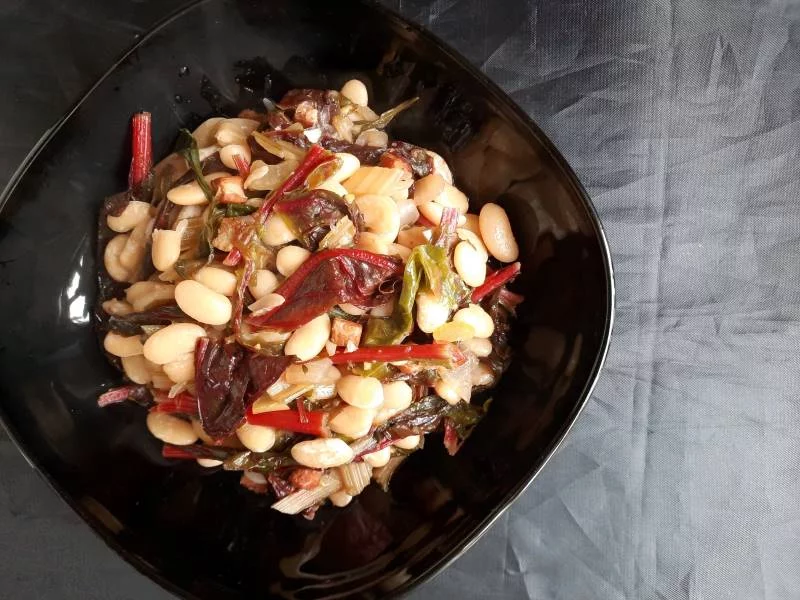
Recipe: Red Chard, White Beans and Pancetta
Makes 6 large or 8-10 first-course servings.
Ingredients
- 2 tablespoons olive oil
- 1/2 pound piece pancetta or guanciale, small diced (see note)
- 1 large yellow onion, peeled and chopped
- 2 bunches red chard, washed and spun or shaken dry, destemmed or stripped of red stems, leaves torn roughly and stems chopped into 1-inch pieces, leaf and stem pieces separated
- 2 ribs celery, small diced
- 1 large carrot, peeled and small diced (optional)
- 6 garlic cloves, minced or slivered
- 1 pound (2 cups) dried white beans such as cannellini, great northern, tarbais or borlotti, rinsed and soaked in cool water for 4-6 hours, drained
- 4 cups chicken broth
- 1 large or 2 medium-sized rinds of Parmigiano-Reggiano cheese (see note)
- 1 teaspoon freshly ground black pepper
- 2 bay leaves
- 1 bouquet garni (optional)
- 4 cups water, or less
- 1 large or 2 medium very ripe red tomatoes, peeled and rough chopped
- Garnishes (optional): extra virgin olive oil; finely chopped flat-leaf parsley, grated Parmigiano-Reggiano or Grana Padano cheese
Directions
In a large pot or Dutch oven, heat the olive oil over medium heat and, in it, cook the pancetta for 15 minutes until it is browned and beginning to crisp. Remove with a slotted spoon or “spider” and reserve.
In the accumulated fat, cook onion for 10 minutes until translucent and beginning to brown. Add the celery, the chard stems (not yet the leaves) and the carrot, if using, and cook for 10 more minutes, stirring. Add the garlic and cook for 1-2 minutes until everything is noticeably aromatic.
Add the beans, chicken broth, cheese rinds, black pepper, bay leaves and bouquet garni, if using. Turn up the heat and bring to a slow boil, then lower to a simmer and cook, uncovered or with the cover ajar (either way is fine) until the beans are just cooked through, anywhere from 45-90 minutes, depending on the choice of beans. Add water to the mix if the beans take on more water than that of the final consistency you desire.
Add the tomatoes and the torn chard leaves and stir well, again adding whatever amount of water you like. The final mix can be thick and stew-like or fluid like a brothy soup.
Serve in heated bowls with any or all of the garnishes, if using.
Note: Pancetta is good but guanciale (cured pork jowl) is better. Specialty grocers or butchers often stock guanciale. Specialty cheese counters or stores sell rinds of Parmigiano-Reggiano (which keep nearly indefinitely in the freezer). They add surprisingly little cheese flavor but buckets of umami. Finally, you may make a version of “pasta e fagioli” by adding small-form dried pasta (such as ditalini, say, or mini-farfalle) about 15-20 minutes before the cooking is completed but you also will need to add more liquid (water or broth).
Bill St. John has written and taught about restaurants, food, cooking and wine for more than 40 years, locally for Rocky Mountain News, The Denver Post and KCNC-TV Channel 4, nationally for Chicago Tribune Newspapers and Wine & Spirits magazine. The Denver native lives in his hometown. Contact Bill at [correo electrónico protegido]