
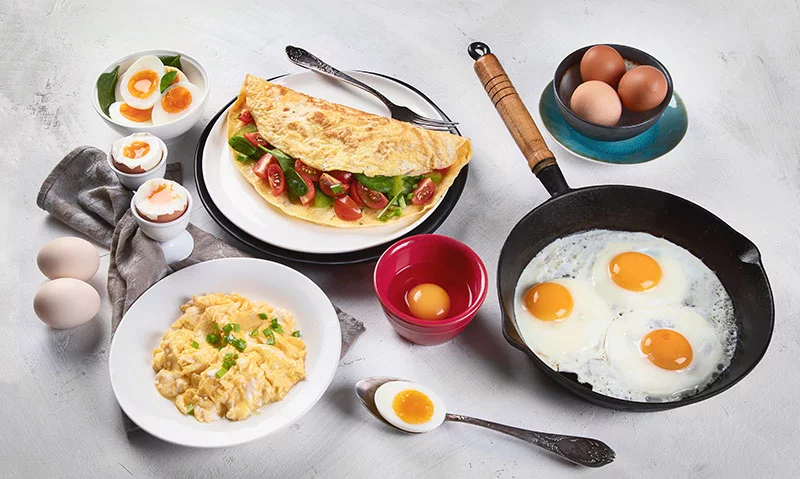
A smidge of science might help immeasurably at this time of year as we invite one of our favorites into the kitchen — the egg.
Hard-boiled (sometimes called hard-cooked) eggs are an Easter mainstay. And Passover’s seder plate sports a hard-cooked egg, its roundness signifying the cycle of life, death, and rebirth connected to the springtime setting of Passover. (It has other symbolisms on the seder plate as well.)
But first, some science and two ways to cook eggs — soft-boiling and scrambling — before tackling the difficulty of hard-cooking and peeling eggs, especially at high elevation.
The science behind cooking eggs
For as simple as it appears, the egg is significantly complex. Knowing its science makes for better eating.
Its two main constituents — the white and the yolk — react to heat in different ways and therein lies any difficulty in cooking the egg.
The white is 88 percent water; the yolk, 50 percent. That moisture turns to steam when heated, the steam differently affecting, in turn, the two kinds of proteins in the white and in the yolk.
The white’s proteins are like a skein or ball of yarn. Heated, they untangle and bond to each other, becoming firmer and firmer and forcing out moisture, hardening finally into a rubbery mass.
The yolk’s proteins are spherical, and set inside each other, like thousands of Russian dolls. You’ll notice that, when overcooked, the yolk isn’t rubbery like overcooked white, but crumbles like chalk.
Basically, I’ve learned that successful cooking of soft boiled eggs and scrambled eggs depends on how I manage the two proteins in an egg.
Soft-boiled eggs
For example, my best soft-boiled eggs blast the whites with heat before slowly working their way into the refrigerator-cold yolk. (I want the white to end up soft at 180 degrees F; the yolk to be runny at 155 degrees F.)
So, I place anywhere from four to eight eggs, just out of the refrigerator, into a bamboo or steel steamer, already set over steaming, simmering water. (Note that, in Denver, that water is 200 degrees F, not sea-level 212 F.)
Either starting eggs in cold water in order to soft cook them, or adding a number of cold eggs into simply boiling water (which lowers the water’s temperature dramatically), doesn’t work. I want to give the super-hot water-as-steam the chance to cook the whites to a higher temperature before it works its way into the colder-temperature yolk to do its job there.
Scrambling eggs
Likewise, when scrambling eggs, I keep those protein structures in mind. (A more proper term than scrambling eggs would be “coagulating eggs,” because that’s what I’m doing to the proteins.)
First, after cracking them into a bowl, I salt the lightly whipped eggs at least 15 minutes, then cook them in a good amount of fat (I use butter). The sodium gets in between the proteins and prevents them bonding in the same way that they would saltlessly. That way, I get more control when the heat hits the pan.
The fat slows down the untangling of the white’s proteins and the too-quick hardening of the yolk’s. The fat also gets in the way of the escape of steam, thus retaining more moisture in the finished scramble.
Hard-cooked eggs at high altitude
Everyone wants two things in a hard-boiled (called by me “hard-cooked”) egg: that it’s cooked through, yet no bitter green ring surrounds the yolk.
And an egg that’s easy to peel.
Getting those two things down, however, is the devil in hard-cooking eggs. Overboiling is manageable, but the peeling is the pain. Blame the latter on the membrane encasing the entirety of the raw egg that lies just below and against the shell. Most hard-cooking methods merely adhere the membrane to the shell, rendering a clean, slick peel difficult, if not impossible.
I’ve tried everything to avoid that: using old eggs because the sticky membrane supposedly has shrunk away; cooking the eggs both on and off the heat of boiling water; poking a hole in the fat end; dousing the eggs in an ice bath to shock the shell away from the cooked white; cracking the egg at only the fat end; cracking the egg all over; peeling under running water—everything. One trick may work one time, but it doesn’t the next. The kitchen gets sad.
I’ve found one way, though, that works nearly all the time: lowering the eggs into already boiling water, rather than the oft-suggested method of starting in cool water that’s then brought to a boil or simmer.
Introducing the eggs that way—it doesn’t matter whether they are cold or room temp—shocks the membrane away from the shell (except, it seems, with eggs fresh from the coop).
For up to 6 hard-cooked eggs, then, bring a couple of quarts of water to a boil, then carefully lower the eggs into the boiling water. Bring the water back to the lowest possible simmer and cook the eggs for exactly 12 minutes at Denver’s mile-high elevation.
(If you’d like yolks that are more orange than yellow, cook for only 10-11 minutes. Still runny yolks at the center, 8-9 minutes.)
Drain the eggs and peel them while they’re still hot under very cold running water—mostly so you don’t burn your fingers.
More tips and tricks for cooking eggs
- Whipping eggs: Old eggs are easier to whip into peaks than fresh. As an egg ages (into 6-7 weeks out of its hen), its pH rises, and the elevated acidity affects the electrical charge of its protein, in the same way that, when whipping eggs, adding cream of tartar (powdered tartaric acid) does.
- Separating whites and yolks: The whites and yolks of fresh versus older eggs are easier to separate because the membrane protecting the yolk (the vitelline) weakens with age.
- Also, separate eggs when they are cold rather than at room temperature because the yolk is firmer in that state.
- Storing eggs: When you travel this summer, you’ll note that, in many countries such as Britain, whole eggs often are displayed on the counter, outside of any refrigeration. Unlike many other governments, ours mandates that fresh eggs be washed before sale, and in so doing, does away with the natural, protective cuticle that forms on each egg at laying.
- How to read the codes at the end of the egg carton: The three-digit number is the date the eggs were washed, graded and packed — not laid — construed as a “Julian” number (January 1st is 001; December 31st is 365). By law, an egg packer has 30 days after the egg is laid to pack it, although in practice, the time is much shorter.
- Understanding sell-by date: The sell-by date is not required, but is often stamped on the carton. It cannot be more than 30 days after packing. Properly stored, eggs remain fresh and tasty 2-3 weeks after the sell-by date, although some things in them are compromised due mostly to evaporation from within the egg (an eggshell is pocked with around 10,000 microscopic pores, all of which easily “breathe” both air and moisture) and deterioration of some inner membranes or elements.
Favorite egg recipes to test your new knowledge, plus more insights on how to cook perfect eggs
-
Two shakshuka recipes, one rich and tomatoey, one bright and green, show how eggs shine when simmered in boldly spiced vegetables and fresh herbs.
-
A bowl of gently cooked congee topped with jammy eggs proves how a simple egg technique can transform an everyday comfort dish.
-
These recipes highlight the beauty of gentle cooking: swordfish slowly poached in olive oil until silky, and a classic frisée au lardons topped with a softly poached egg, crisp bacon and tangy dressing.
-
These heart‑healthy egg recipes make everyday meals easy and satisfying, from freezer‑friendly breakfast burritos to a veggie‑packed frittata and a lighter take on classic egg salad.
- Create a delicious Salade Niçoise which incorporates hard-boiled eggs with fresh vegetables and canned tuna.