
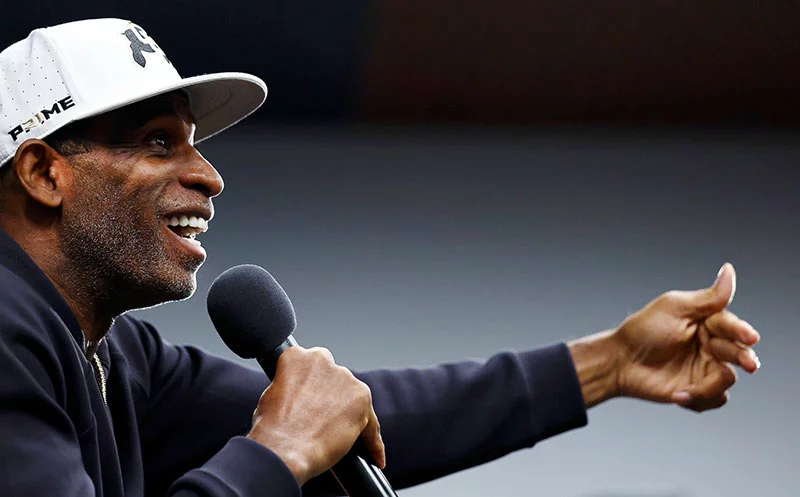
That a pro football Hall of Famer and the Emmy-winning sportscaster swapped stories in front of a live audience and various cameras — nothing out of the ordinary there.
That the discussion started with respective funny/not-funny anecdotes about incontinence episodes related to urologic cancer surgery, and, in the subsequent hour, scarcely touched on athletics? Extraordinary.
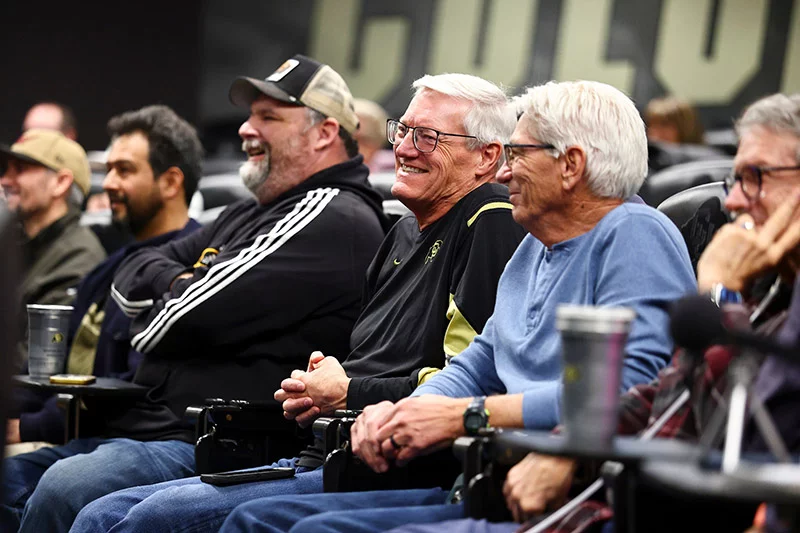
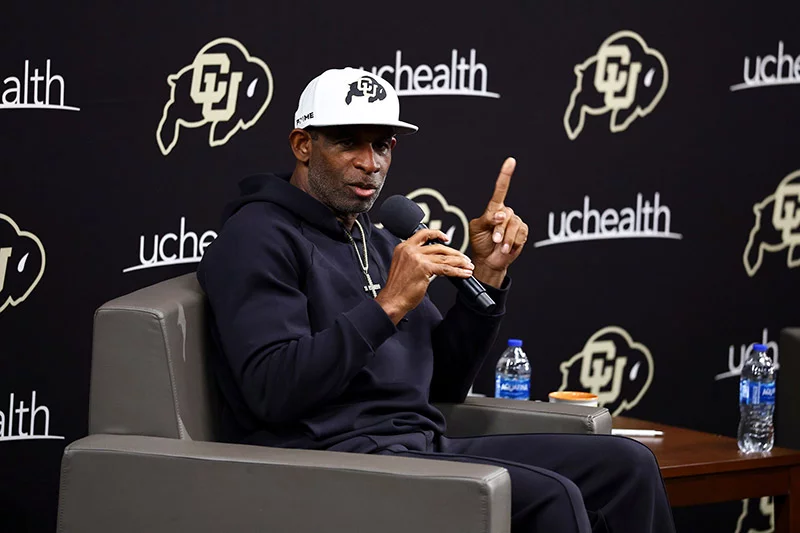
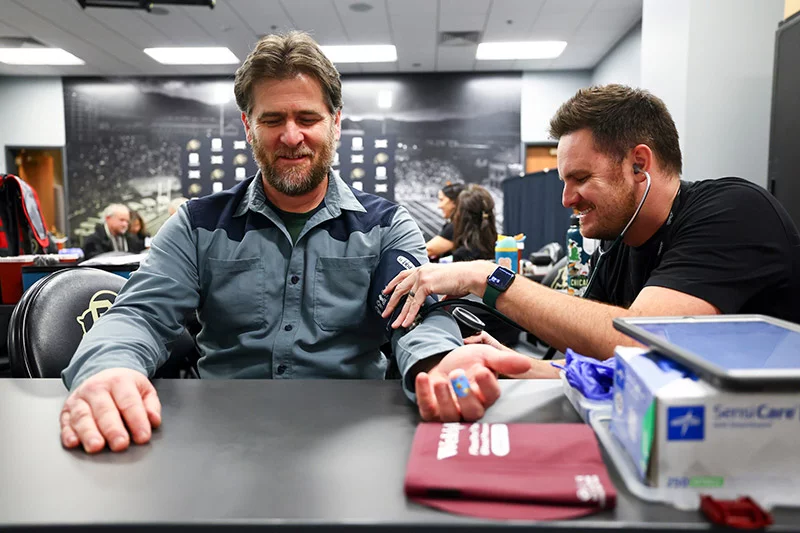
University of Colorado head football coach Deion “Coach Prime” Sanders recently joined Altitude Sports anchor Vic Lombardi, who is fighting prostate cancer, at the UCHealth Champions Center at Folsom Field for “Prime Perspective.” The December event, attended by about 130 people, was part of MANtenance Live presented by UCHealth. The MANtenance campaign encourages men over 40 to seek medical care when needed and improve their health. In addition to the discussion, UCHealth providers offered health screenings, including a lipid panel, blood glucose, blood pressure and a consultation on heart disease, diabetes, and stroke risk based on the results and other information collected via an online survey.
Getting the word out on men’s health
Sanders, 58, hasn’t been shy about sharing the health challenges he has in faced in recent years — including blood clots in his lower leg that cost him two toes and, this year, bladder cancer. He says he was blessed by God with athletic gifts that have manifested publicly and feels that going public with his own health setbacks can help others improve their health and cope with setbacks.
“This ain’t just about no darn football. This ain’t just about CU. This is about people,” Sanders said. “I don’t feel like this is a loss. I feel like it’s a gain, because now we’re preparing so many more people to understand the trials and tribulations in the process [by being] transparent.”
Before the hour was up, he would find out just how directly the influence of his bladder cancer story has been.

An incidental bladder cancer finding
That story, in a nutshell: In early April, Sanders underwent a routine scan to check for blood clots, which he’s genetically susceptible to. The scan turned up an incidental finding: bladder cancer.
Many bladder cancer diagnoses come after noting blood in one’s urine. Sanders had no symptoms. He had been similarly scanned six months earlier, and the bladder was fine. Now he had an aggressive tumor covering a quarter of it.
They had caught the cancer at stage 1, before it spread beyond the bladder or into its muscular wall. But any bladder cancer is serious: It’s the 10th-leading cause of U.S. cancer deaths, with men accounting for 77% of cases.
Dr. Janet Kukreja, who is director of urologic oncology and cares for patients at UCHealth University of Colorado Hospital, presented Sanders with his options. He could go through a three-year course of treatments with repeat hospital visits involving the injection of chemotherapies directly into the bladder. Given Sanders’s aggressive tumor, though, Kukreja told him that following that path would bring a 15% chance of recurrence, in which case his survival chances would be about 50-50.
Three years of chemotherapy or a ‘radical’ surgery
The other option was to remove the bladder and surgically create a replacement using a section of small bowel — a radical cystectomy with neobladder. Kukreja, an associate professor at the University of Colorado School of Medicine on the Anschutz Campus in Aurora, happens to be one of the top U.S. surgeons performing the procedure using a surgical robot. Sanders considered the cancer risk as well as his own busy schedule and personality.
“I’m not coming down there every week after practice. I know me, I’m not gonna do that,” he said. “I’m gonna get bored with it, and I’m gonna be mad, and I’m gonna be upset, and I don’t want to come there with an attitude.”
He went with the surgery.
Kukreja performed the surgery in May, and it went well. Sanders recovered at his home in Texas.
Coach Prime faced a typically tough recovery
Radical cystectomy is a life-saving surgery followed by a brutal recovery process. Sanders had no energy, no appetite, shed 25 pounds from lean frame.
“I think I went through some kind of depression, because, you’ve got to understand, coming from an athlete that has been an athlete of athletes, and then getting amputated, can’t run like I used to, can’t move like I used to, then to this now,” he said, recalling his mindset in the days following surgery. “I didn’t have the strength to even get up or to eat, weight has just fallen off of me, I can’t use the bathroom, I can’t do anything — that was hard.”
A neobladder may, over time, expand to hold a similar volume of liquid (early on, it’s much less than a bladder), but it’s not a bladder. The surgery disconnects nerves that send signals telling you it’s time to use the bathroom, and it also affects bladder control. A year out from surgery, about 84% of patients have no daytime incontinence problems. At night, though, it’s only about 63%.
Sanders is already among the 84%; he’s not among the 63%.
When Kukreja joined the MANtenance discussion, Lombardi asked her, “Doc, does it get easier over time? Will it get easier at night?”
Kukreja paused. Then she said, “The major downside of neobladders is the nighttime leakage.”
A press conference makes a big difference for a man in Colorado Springs
Sanders felt strong enough to go public with his bladder cancer story on July 28, at a press conference also featuring Kukreja. Quinn Quintana, a 61-year-old engineering manager and University of Colorado Boulder graduate who lives in Colorado Springs, caught the story on a national newscast. His daughter, Marie Williams, a registered nurse who lives in Erie, sent him a link to the full video.
Quintana had first noticed blood in his urine in the summer of 2024, but didn’t get to a urologist until that December. He was diagnosed with stage 4 bladder cancer. He underwent chemotherapy for months and, despite being aware of bladder removal as an option, had been holding out hope that he could keep it.
“You have to watch what Deion says — get it done. Get it over with,” Williams told her dad.
Quintana met with Kukreja and other specialists at UCHealth University of Colorado Hospital. They told him his survival chances were far greater with bladder removal. Kukreja performed a radical cystectomy with neobladder on Sept. 26.
Men: Take charge of your health
Three months later, Quintana was feeling strong enough to return to work before year-end. He marveled that Sanders was back on the sideline as quickly as he was, the sideline bathroom notwithstanding. He concurs with Sanders that the early weeks of recovery from the surgery are brutal, but that being cancer-free is worth the price.
“They’re pretty optimistic that I probably will be OK,” Quintana said.
He also agrees with Sanders that men should take charge of their health better than they often do.
“The reason I’m in this position is that, as males in this society, you really don’t go to the doctor,” Quintana said. “You just tough it out, and if you detected this early, you probably don’t have any of this and the worry about dying.”
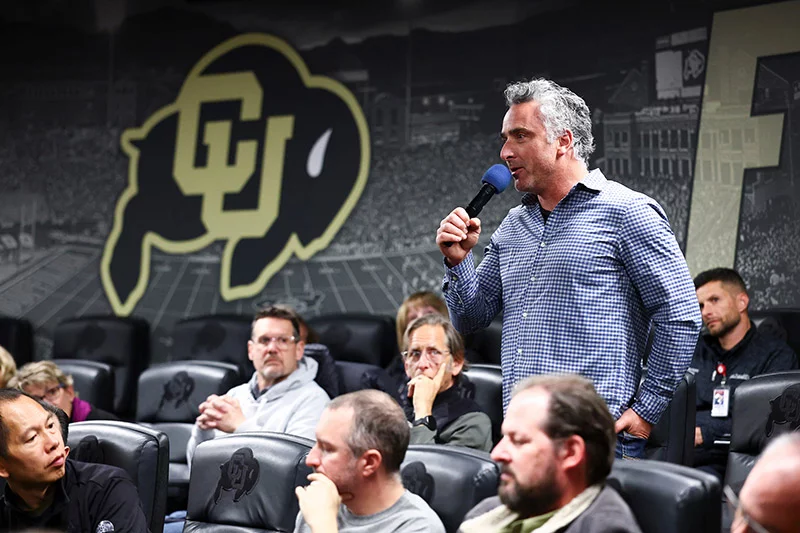
Quintana’s daughter Williams attended the Prime Perspective MANtenance event. During the Q&A session, she told Sanders and Kukreja her dad’s story and thanked them both.
“Please tell I’m praying for him, and I know what he’s going through, and he’s going to make it,” Sanders told her.
Quintana got the message.
“That’s really cool that he would say such a thing,” Quintana said. “Deion, he’s obviously a legend. He’s bigger than life.”