

A recent deadly outbreak of hantavirus on a cruise ship that traveled from Argentina to the Antarctic, then through the South Atlantic Ocean, has renewed attention on this rare but very serious disease that health experts have tracked for years in Colorado and southwestern states in the U.S.
On May 2, 2026, health experts at the World Health Organization received word of “a cluster of severe acute respiratory illness, including two deaths and one critically ill passenger,” aboard a cruise ship that had left Argentina on April 1 and traveled to several islands in the South Atlantic Ocean.
Within a day of the notification, medical experts confirmed that passengers on the cruise ship had contracted hantavirus pulmonary syndrome, and three people have died so far.
Hantavirus typically does not spread from person to person, but medical experts are researching exactly what happened to the cruise passengers.
While that outbreak was far from Colorado and the American Southwest, people in the U.S. should always be on guard against hantavirus.
While hantavirus infections are uncommon, they can cause severe lung infections in humans. People usually contract hantavirus when they’re exposed to infected rodents and their droppings, urine or saliva, particularly during spring cleaning and outdoor activities, where the fecal particles become aerosolized.

“It’s a function of inhaling the virus,” said Dr. Michelle Barron, UCHealth’s senior medical director for infection control and prevention and a professor of medicine and infectious diseases at the University of Colorado Anschutz School of Medicine.
Human-to-human transmission of hantavirus is extremely rare. However, cases have been linked to a specific species of the disease, called Andes virus, which circulates primarily in South America.
Health experts at the WHO are investigating what led to the recent outbreak. As of May 5, it wasn’t clear whether passengers had contact with wildlife during their voyage or before boarding the cruise ship. Health experts warn, however, that human-to-human transmission could occur in regions where the Andes virus is endemic, including Argentina. They advise people who are visiting rural communities or who are camping or hiking in these regions to take precautions to reduce their risk. (If you’re planning a big trip, learn more about visiting a travel clinic so you can get necessary medications and vaccines. There is not yet a vaccine that prevents hantavirus.)
Hantavirus infections are uncommon overall — fewer than 1,000 cases have been reported in the U.S., according to WHO — but most cases occur in rural areas, where rodents are more prevalent. That is why the virus poses a greater risk in rural parts of Colorado and the Southwest.
Hantavirus in Colorado and other parts of the U.S.
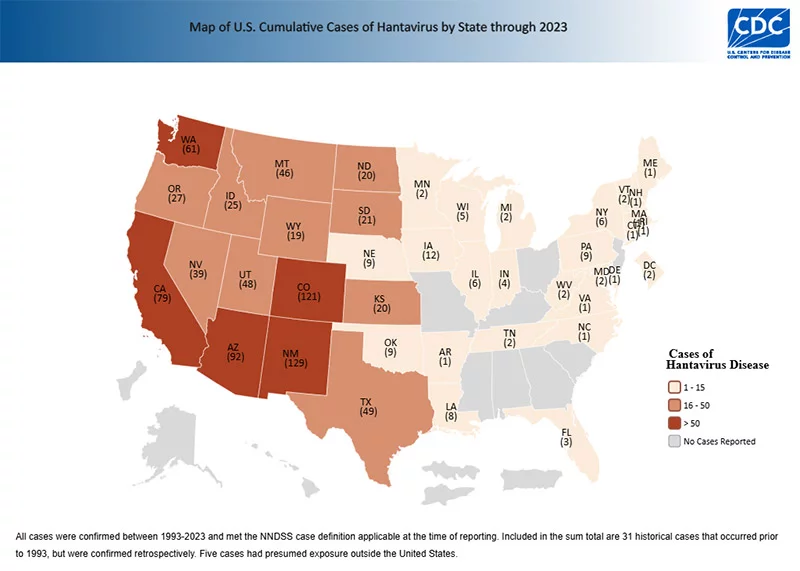
According to data from the U.S. Centers for Disease Control and Prevention (CDC), Colorado has logged the second-highest number of cases of hantavirus in the U.S. since the CDC started tracking cases in 1993. From 1993 through 2023, CDC officials logged 121 hantavirus cases in Colorado.
The virus is very dangerous for those who get it. Of the 121 who contracted the illness, 45 died.
In 2024 in Colorado, there were five cases of hantavirus, and two of the people died, according to Kristina Iodice of the Colorado Department of Public Health and Environment.
Only New Mexico has recorded more confirmed hantavirus cases. New Mexico health officials documented 129 hantavirus cases from 1993 to 2023, and 54 of those who contracted the virus died.
Adding to those statistics in 2025 were the sad deaths of legendary Hollywood actor Gene Hackman and his wife, Betsy Arakawa, in New Mexico.
Arakawa, 65, died of hantavirus, according to Dr. Heather Jarrell, the chief medical investigator at the New Mexico Office of the Medical Investigator.
Arakawa was believed to have died sometime around Feb. 12, 2025, while Hackman, 95, who suffered from Alzheimer’s and cardiovascular disease, is believed to have died about a week later on Feb. 18 at their home in Santa Fe. The couple’s bodies were discovered on Feb. 26, along with their dogs, one of whom was in a crate and died along with Hackman and Arakawa. Medical experts in New Mexico do not think Hackman or the dog died of hantavirus. But they have confirmed that Arakawa contracted it.
So, what causes this unusual virus? Is it typically deadly? Who should worry about it, and how can you protect yourself?
To learn more about hantavirus, we consulted with Lauren Bryan, an infection preventionist at UCHealth Yampa Valley Medical Center.
What is hantavirus?
Hantavirus is a family of viruses that rodents can carry. Different strains can be found in different places around the world, and more than 20 viral species have been identified. Orthohantavirus andesense (also referred to as Andes virus) is most dominant in South America. In Colorado and the Southwestern U.S., the virus strain is Sin nombre (or Spanish for ‘no name’), and it’s carried by deer mice.
“It’s important here in Colorado because we have a fair amount of deer mice,” Bryan said.
Since 1993, hantavirus has sickened and killed people in rural areas of Colorado. It’s rare, but it can be very deadly, with up to 40% of people who get the illness dying of it.
What is the most dangerous time of year for hantavirus?
Peak season for hantavirus is spring and early summer.
“That’s when people are starting to go in and clear out their sheds and garages where deer mice have been nesting,” Bryan said. “The bodily fluids from the mice carry the virus. So if people sweep up excrement or touch dead mice or get bitten, they may be exposed.”
“People are sweeping or cleaning without the windows open,” Barron added.
The virus particles that spread hantavirus from mouse droppings then float in the air or become aerosolized.
“You then can breathe it in and then it can become infected,” she said.
She recommends that people air out spaces before cleaning them. And they should always wear masks while working.
What kind of mice spread hantavirus? How do I know what kind of mice I might have if I see them?
Deer mice spread hantavirus. They have distinct tails that are dark on top and lighter on the bottom. But most people who get hantavirus don’t see mice. So, it’s best to take precautions whenever you are dealing with mice and cleaning up droppings.

What if I don’t see a mouse? Am I still in danger of getting hantavirus?
In about a third of all confirmed cases in which humans contracted hantavirus, people said they never saw a mouse, Bryan said.
“So any time you’re going in and clearing out those areas, it’s important to be aware of it,” Bryan said.
What are the symptoms of hantavirus?
On average, symptoms of hantavirus start two weeks after exposure, but can appear between one and six weeks anytime. Fever and chills may be experienced, but everyone who is infected has severe leg, hip and back pain.
“That’s the really distinct feature of the virus,” Bryan said. “You may not get the other symptoms, but you will have leg or hip or back pain that doesn’t go away with ibuprofen or Tylenol.”
The virus can progress quickly, causing inflammation in the heart and lungs, which may result in fluid buildup in the lungs and eventually death.
In the case of the cruise ship, one person who died of hantavirus presented first with a fever, headache and mild diarrhea. He developed respiratory distress a week later before dying the same day. Another only had a fever and “general feeling of being unwell” just days before she died with pneumonia.
Fatalities among people who get hantavirus are very high. Are there any effective treatments for hantavirus?
Anyone experiencing symptoms of hantavirus should seek medical attention immediately: there’s no cure for hantavirus, but various treatments — such as blood pressure support — can help counteract the effects of the symptoms.
A simple blood test can show the presence of hantavirus.
Is there a vaccine for hantavirus?
There is no vaccine for hantavirus, but precautions can be taken to prevent infection.
Do people in urban areas need to worry about hantavirus?
Confirmed cases of hantavirus are more common in rural areas of Colorado and elsewhere in the U.S., but medical experts have recorded cases among people in urban areas.
For instance, a Denver woman who did extensive maintenance work and plumbing may have been exposed to hantavirus after some ceiling tiles collapsed on her while she was working in Denver. She hadn’t spent much time in rural areas of Colorado before becoming infected. The woman survived hantavirus.
Medical experts advise anyone cleaning or working in mouse-infested areas to wear masks.
How can I prevent mouse infestations and avoid getting sick from hantavirus?
“Ultraviolet light actually kills the virus,” Bryan said. “Open up and air out the spaces you’re trying to clean and let the sunlight in before you go in and do anything.”
Keep mice from nesting in the first place by caulking and rodent-proofing your home, and trapping mice that have already gotten inside.
“Handwashing is important too, as some transmission happens when people clean up, and then touch their mouth, nose or food they’re eating,” Bryan said.
The virus can also be inhaled, so medical experts at the U.S. Centers for Disease Control and Prevention recommend wearing protective gear when cleaning areas with potential mouse infestations.
And remember that oftentimes, instead of seeing the small, brown deer mice, you’ll just notice signs of their presence.
“You may see nesting materials, such as straw, or excrement,” Bryan said. “Or the mice may chew stuff up and make holes in dog food bags and other food containers.”
All of those efforts to keep mice out of the house pay off in other ways: mice also carry ticks, which can spread diseases such as Colorado Tick Fever and Rocky Mountain Spotted Fever.
“Rodent proofing areas is really important for a number of reasons,” Bryan said.