
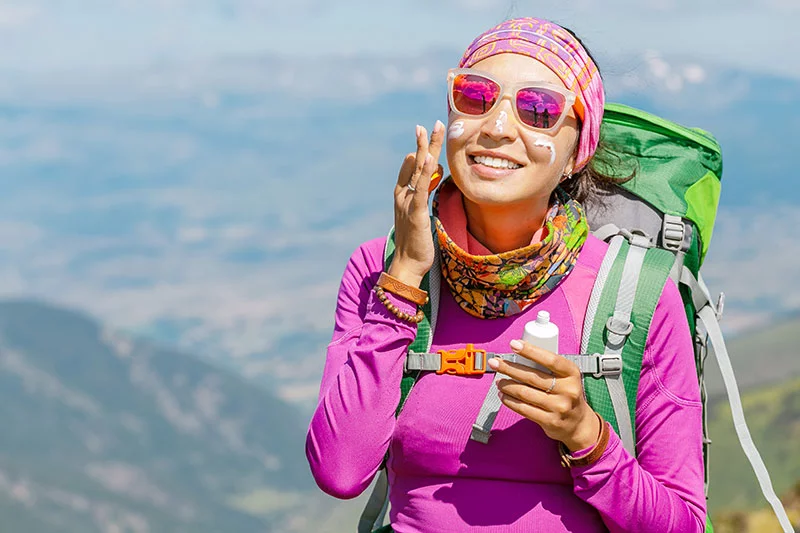
Colorado boasts as many as 300 days of sunshine each year. These sunny days are one reason Colorado is such a great place to enjoy outdoor activities, including hiking, biking and skiing.
But one downside all this sunshine is the potential for excess exposure to the sun’s ultraviolet rays. Because of sun exposure at high altitudes, Colorado has one of the nation’s highest per-capita rates of skin cancer.
The good news is that you can reduce your risk of developing skin cancer without hiding inside all day, and it starts with how you protect your skin.
To answer your top questions about the importance of sunscreen and preventing skin cancer, we consulted with various UCHealth experts.
Understanding UV rays from the sun
Located approximately 93 million miles away, the sun provides heat and energy for Earth and the gravitational pull for our solar system.
It also produces ultraviolet (UV) light, rays that are like invisible radiation. This intense light can damage skin cells, which leads to skin cancers and premature aging.
There are two types of UV rays. The UVA rays, which account for about 95% of UV exposure on Earth, have longer wavelengths, allowing them to penetrate deeper into the skin.
UVB rays make up the remainder of the sun’s rays that reach Earth. These don’t penetrate deeply into the skin but are very high-energy and damage the skin’s surface layer.
How snowpack and sunshine damage skin
In Colorado, the peak of the snowpack typically happens in early April, meaning some snow will linger on the ground after the height of the deepest snows.
And even with this year’s record-breaking low snowpack — just 29% of average on March 28 — the reflective light from the snow at any time of the year can be a double whammy on skin.
“Snow can reflect up to 80% of the UV rays back at you, nearly doubling your exposure,” said Dr. Maxine Warren, a dermatologist who cares for patients at UCHealth Estes Valley Medical Center. “This is why it is critical to apply sunscreen to any exposed skin before hiking, skiing or any other outdoor activities.”
Be sure to use sunscreen on cloudy days and during all seasons
Although you might think sunscreen isn’t necessary on cloudy days, the UV rays, particularly UVA rays, still penetrate overcast clouds. It is these types of rays that can cause the most damage to skin by accelerating the aging process, creating excessive fine lines and wrinkles, and leading to increased risk of skin cancer.
“Freckles and larger sunspots — we call them ‘lentigines’ — are signs of sun damage,” said Warren. “When these are changing shape or becoming darker, you should get them evaluated. Skin cancer spots can also be pink and scaly, so anything that is not healing after a few weeks should get checked out.”
According to the Skin Cancer Foundation, skin cancer is the most common cancer in the U.S., with one in five Americans developing the disease by the age of 70.
The organization also states that about 90% of non-melanoma skin cancers and about 86% of melanomas are associated with exposure to UV radiation from the sun.
They also report that when detected early, the five-year survival rate for melanoma is 99%.
Elevation can also impact the intensity of UV rays
Colorado’s higher elevation means you need to be extra careful when you’re venturing outdoors. In Estes Park, where Warren is based, the elevation is 7,522 feet. When venturing into nearby Rocky Mountain National Park, visitors can drive as high as 12,183 feet along Trail Ridge Road.
The views are spectacular at higher elevations in the park, with peaks visible as far away as southern Wyoming and Summit County, Colorado, but the higher you climb in elevation, the more the UV intensity also increases.
“UV intensity increases by over 5% per 1,000 feet of altitude gained,” said Warren. “In Estes Park, we are around 7,500 feet above sea level, so we have more than 35% strong cancer-causing and aging rays.”
Remember to protect the less obvious skin locations
For all of these reasons — and so you can get out and explore Colorado’s beauty — it’s essential to apply sunscreen on all exposed areas of skin when spending time outdoors during any season.
Warren stresses that some of the most vulnerable areas of skin include the face, ears, the back and sides of the neck, and the backs of the hands if not wearing gloves. Think of all the places that the sun may be directly hitting skin or reflective rays may be bouncing back onto skin from the surface of snow or water.
For example, if someone wants to go fishing along a river in Colorado, be sure to apply sunscreen to the face, and also remember to apply lotion to the tops of the ears if they are not protected by a hat, and to the underside of the chin and the neck. These less-considered areas receive just as much light due to the reflective nature of sunlight on the surface of the water.
Another example would be hiking a trail near Denver in sandals. The trail may be flat and easy to navigate, and thus does not require hiking boots, but the tops of the feet are now susceptible to direct sunlight. Although the strap pattern on Chacos might be a rite of passage signifying dedication to the outdoors, it can also make the tender skin of the feet more prone to early aging and skin cancer.
Sunscreen is an outdoor lover’s best friend
Sunscreen is so important for outdoor recreation that it is included in the sun-protection portion of the ten essentials for hiking and camping, a list that includes everything a person needs to stay safe when outdoors.
According to Warren, people should apply sunscreen 15 minutes before they plan to venture outside. And you should reapply it approximately every two hours. As the day goes on, if you don’t reapply sunscreen or you’re sweating and the lotion is rinsing off, you’ll lose the benefit of the sunscreen.
“Many dermatologists like to say, ‘the best sunscreen is the one you will use,’” Warren said. “Try several different brands and see which one you like the most for your skin, whether it’s something non-greasy, glowy, tinted, moisturizing or matte. You also want to see “broad-spectrum” on the bottle and protection against both UVA and UVB rays.”
What other types of sun protection items should I use?
Other types of sun protection include sunglasses, hats, scarves and gloves to protect eyes, ears, face, neck and hands, as well as lip balm with an SPF rating for lips.
The Skin Cancer Foundation advises skin protection through their helpful mnemonic Five W’s (& H) of Sunscreen:
- Who: Everyone under the sun.
- What: Broad spectrum SPF 30 or higher; SPF 50 or higher for a day outdoors.
- When: Every day; 30 minutes prior to going outdoors. Reapply every two hours.
- Where: All exposed skin.
- How: One ounce (shot glass full) to entire body for each application.
- Why: Reduce your risk of skin damage and skin cancer.
In addition to sunscreen, enjoying the outdoors should also include using a lip balm with an SPF rating, along with wide brimmed hats and gloves.
Does sunscreen expire? Do I need to pay attention to the date on my sunscreen bottle or tube?
Yes. Sunscreen creams, lotions and sprays expire.
“We recommend discarding sunscreen after two years,” said Warren. “Sunscreen can also protect skin against windburn by providing a moisture barrier, since the elements can strip the skin’s natural oils away from the surface.”
Treating a sunburn
Even with the best of intentions, sunburns do happen. In these cases, Warren recommends applying a thick, gentle moisturizing cream to soothe the area. She also advises people to avoid the sun once they have a burn. That’s because burned skin is extra sensitive to UV rays and cannot handle the additional exposure.
Applying aloe vera can help cool the skin and reduce the burn’s intensity. Ibuprofen can help relieve pain. A bag of ice wrapped in a towel or a cold compress placed on the burned skin can also help reduce pain, swelling and heat.
If the burn is worse than a superficial redness, such as with blistering and severe pain, seek medical attention.
When, where and how should I apply sunscreen to best protect my skin?
Whenever you’re outside, and your skin is exposed, whether it’s cloudy and cold or hot and sunny, you should wear sunscreen, said Dr. Aly Barland, a dermatologist at the UCHealth Dermatology Clinic in Longmont.
“Sunscreen is the best weapon we have against protecting our skin from ultraviolet radiation, which can lead to aging of the skin and skin cancer,” Barland said.
An ounce of sunscreen, approximately the size of a shot glass, is enough for your entire body. Be sure to apply it before you head out so it has time to dry. The best way to apply sunscreen is to squeeze some lotion onto your hands and rub it directly on your skin.
Do sunscreen sprays work?
Sunscreen sprays don’t work as well as creams and lotions.
“Usually, a cream or lotion is more effective than a spray because you may not be directly applying the sunscreen to your skin since some of it is aerosolized. You get a more even layer of sunscreen when you use a cream or lotion and apply it with your hands,” Barland said.
Dr. Rebekah Zaluzec, a plastic and reconstructive surgery expert at UCHealth Cherry Creek Medical Center, recommends broad-spectrum UV sunscreen, which protects against both UVA and UVB rays.
“Start by applying first thing in the morning, and it is really important to reapply in the afternoon. Reapplying is what people find the most challenging because we tend to forget, Zaluzec said.
Is mineral sunscreen or chemical sunscreen better?
The best sunscreen is the sunscreen that you use regularly. Whether it’s chemical or mineral sunscreen, a spray or lotion, the type isn’t as important as the effort.
As for ingredients, Barland said, it’s a matter of preference when it comes to using a mineral sunscreen or a chemical sunscreen. For those with sensitive skin or concerns about chemical ingredients, a mineral sunscreen would be the best option. The only two mineral sunscreen ingredients available are zinc oxide and titanium dioxide. These ingredients sit on your skin as a shield against the sun’s ultraviolet rays. They are not absorbed into your skin or bloodstream.
Recent studies have found that chemical ingredients, such as avobenzone and oxybenzone, are absorbed into the skin and subsequently enter the bloodstream. However, it’s not known at this time if those ingredients are harmful.
“We do not yet know the implications of chemical absorption and whether it is harmful,” said Barland. “We do know that skin cancer can be deadly. If people are hesitant about sunscreen use and these studies, they can stick to mineral sunscreens only.”
Does waterproof sunscreen work? How often do I need to reapply sunscreen if I’m swimming?
Many people think that slathering on sunscreen once is fine. Not true. Sunscreen wears off, especially if you’re sweating or swimming. The general rule is to reapply every 1 to 2 hours, and more often if you’re swimming.
If you’re spending time in water, you should reapply as soon as you get out of the pool.
“If you’ve been swimming or sweating, reapplying is important because water-resistant sunscreen is not waterproof, and it also washes off some in the water or with sweat,” Barland said.
What SPF do I really need?
Barland recommends a sun protection factor, or SPF, of at least 30. SPF tells you how long the sun’s ultraviolet rays would take to cause damage to your skin. So, if you use an SPF 30 product, it would take 30 times longer to burn than if you weren’t wearing sunscreen.
The higher the SPF factor, the longer you’re protected, to a degree. For one, it’s only an accurate number if you apply the sunscreen as directed, meaning an ounce for your entire body and reapplying it regularly throughout the day.
“I generally recommend SPF 30 to 70. Beyond SPF 70, you’re probably not gaining much more in protective level,” said Barland.
For kids, do you need to use a specific sunscreen? And what about babies? Is sunscreen safe for infants?
Children under six months should not wear sunscreen. But it’s vital to protect them from the sun with protective clothing and shade. For children older than six months, any sunscreen will do. You do not need to use a sunscreen that’s made specifically for kids.
Mineral sunscreen, however, may be a better option for children.
“For kids older than six months, any sunscreen is fine. But we typically recommend sticking with a mineral sunscreen for kids because they tend to have more sensitive skin, and mineral sunscreens are less irritating,” Barland said.
How else can I protect my skin from the sun?
In addition to sunscreen, wear a wide-brimmed hat and sunglasses, and limit sun exposure between 10 a.m. and 4 p.m. when the sun’s rays are the strongest. You should follow these sun protection guidelines throughout the year.
“In the summer months, when sunscreen is hard to reapply, wear UPF-rated clothing to cover the skin; wear long sleeves, etc., which can make consistency easier. Sometimes it may be hard to remember or keep up with sunscreen application, so this can be a great solution,” Zaluzec said.
Obviously, you don’t have to cover your body with sunscreen when you’re skiing. But you should protect any exposed skin.
“It’s important to remember that the sun is always present, no matter what season we’re in. You need to protect your skin throughout the year,” Barland said.