
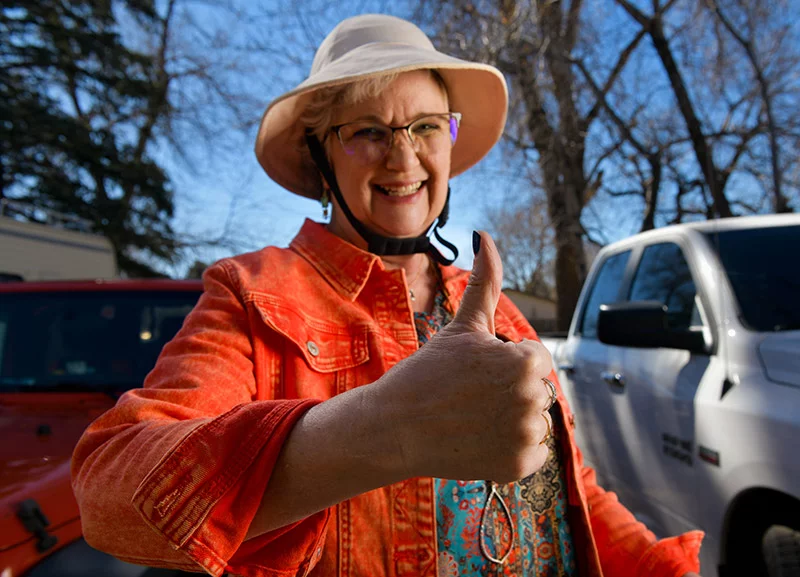
The first patient in the western U.S. to receive a new type of thumb arthritis surgery has a few simple words for others who may be pondering surgery to cope with pain and reduced grip strength.
“Don’t wait. You will be amazed,” said Traceyrené Martz Delgado, who received what’s known as a Touch CMC 1 thumb prosthesis on her right hand on Feb. 16 at UCHealth University of Colorado Hospital.
The new surgery leads to much faster recovery times and less post-surgical pain than the traditional thumb surgery, which is known as CMC arthroplasty. CMC stands for the carpometacarpal joint at the base of the thumb.
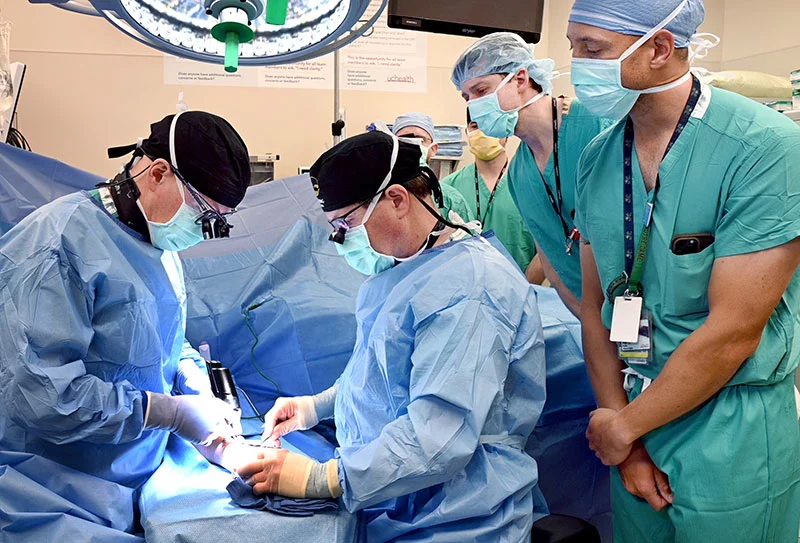
A team of orthopedic surgeons led by hand surgeon Dr. Louis Catalano performed Delgado’s procedure in February and went on to perform the surgery for another four patients before the doctors left the operating room on that first day. The innovation had been a long time coming.
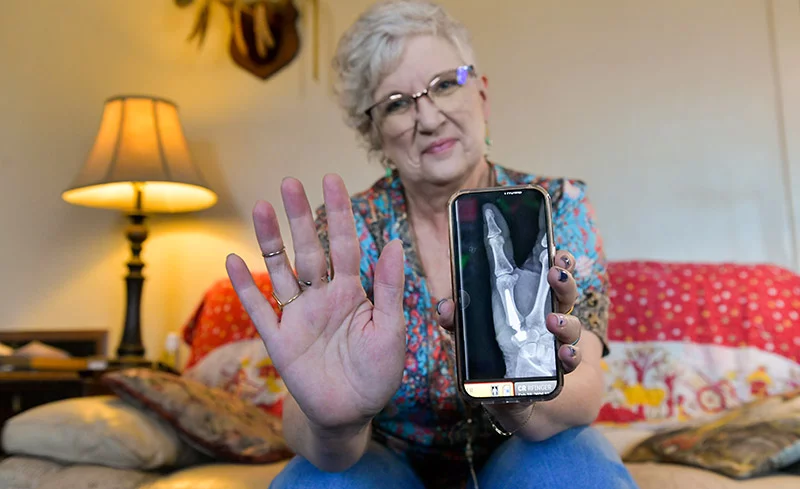
The Touch CMC 1 artificial thumb joint was developed and proven to work well in Europe
Arthritis of the thumb’s CMC joint affects an estimated 7% of men and 15% of women — and as many as one-third of postmenopausal women. It hurts, it weakens your grip, and it can lead to deformity as the thumb recedes into the palm with arthritic joint degeneration. When supportive braces, over-the-counter pain relievers, ice, and steroid injections stop working, surgery is the best option.
Traditional CMC surgery works well, but it comes at a cost. There’s pain for weeks after the procedure, recovery time is measured in months, and, often, there’s diminished long-term strength and a slightly shorter thumb.
European medical device company KeriMedical tackled the problem, and in 2018, its Touch CMC 1 Dual Mobility Trapeziometracarpal Prosthesis — the Touch CMC 1 — was approved in Europe. Since then, more than 150,000 European patients with thumb arthritis have had one implanted to replace a thumb-base joint.
Based on the successes in Europe, experts at the U.S. Food and Drug Administration granted premarket approval for the device in July 2025. The University of Colorado Anschutz School of Medicine team then prepared to bring the new surgery to the Mountain West and did extensive training in France, Belgium, and Switzerland.
Delgado, 58, says she was eager to become the inaugural UCHealth patient regardless, but the implant’s track record in Europe “made me not think twice about it.”
“I would have thought about the drawbacks,” she said. “But knowing they had done 150,000 surgeries over eight years, why would I question that?”
Limitations for Delgado grew as her pain increased
Delgado was well motivated. Her thumb joints started to hurt about 15 years ago and started getting much worse over the past few years. She can’t pinpoint an exact cause, but her hands and thumbs have served her well over many years. And she suffered wear and tear over time. Delgado volunteered as a firefighter and mountain rescuer in Idledale years ago. And she used her thumbs daily to count money as a credit union teller, where she now works as an assistant branch manager.
By the time Delgado came to UCHealth in September 2025, she was dealing with two arthritic thumbs. When Catalano mentioned the Touch CMC 1 as an option coming soon, she was all-in.
“I’m an all-in kind of person,” Delgado said.
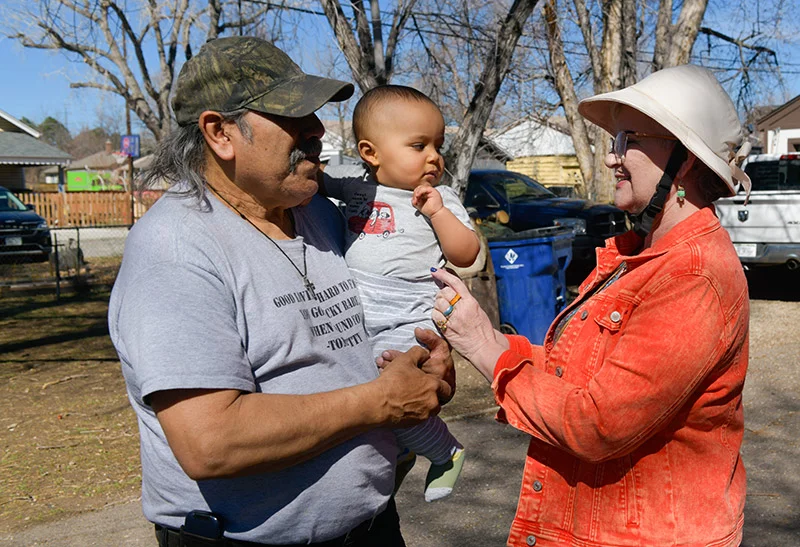
But it’s hard to be all-in when you’re in pain. Counting and handling money at Canvas Credit Union in Arvada hurt. Typing and texting hurt. Wiping things down, sweeping, vacuuming around the house and making the bed hurt. Rather than just swiping or tapping on her phone’s screen with her thumb, Delgado had to hold it in one hand and swipe with the other hand’s index finger. She had to give up on doing origami. She had a hard time holding pans when cooking. She dropped things — drinking glasses especially.
“We don’t have a full set of any kind of glasses anymore,” she said.
Perhaps worst, holding her baby grandson Jermaine hurt, and the lack of strength and instability she felt limited how often she did so.
No cast needed with new thumb surgery
On March 19, just over a month after the Touch CMC 1 surgery, a faint inch-and-a-half-long scar ran along the bridge of Delgado’s right thumb as that hand helped support 11-month-old Jermaine high on her hip.
“It’s been really cool to see the improvement so far,” said Jermaine’s mom, Maggie Delgado, as she observed the moment outside Delgado and husband Ray Delgado’s Lakewood home.
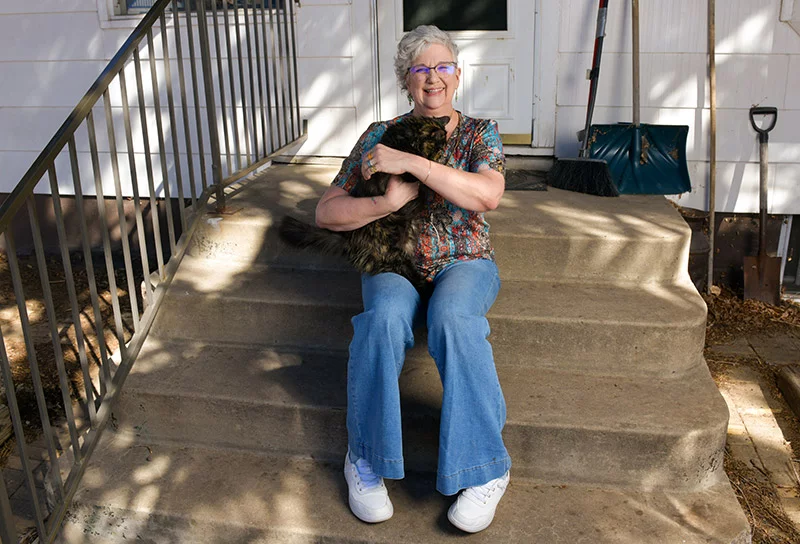
Rather than a cast or a big, hard splint, as is standard after a traditional thumb CMC arthroplasty, Delgado left the outpatient Touch CMC 1 procedure with her hand wrapped in gauze and an ace bandage. She took just two pills of the opioid pain medication Catalano had prescribed before switching to Tylenol. A month later, she only takes that after “a really long, rough day.”
“At no time was the pain worse than before the surgery,” Delgado said.
For six weeks after the surgery, she is to wear a thumb brace at night, mainly to avoid inadvertently rolling over on it. She’s also doing rehab exercises involving different thumb motions on her own five times a day.
Back on the bike, thanks to a surgically repaired thumb
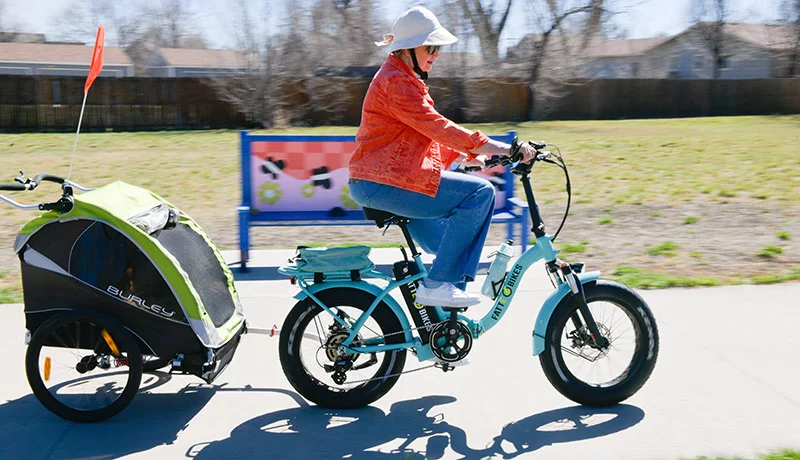
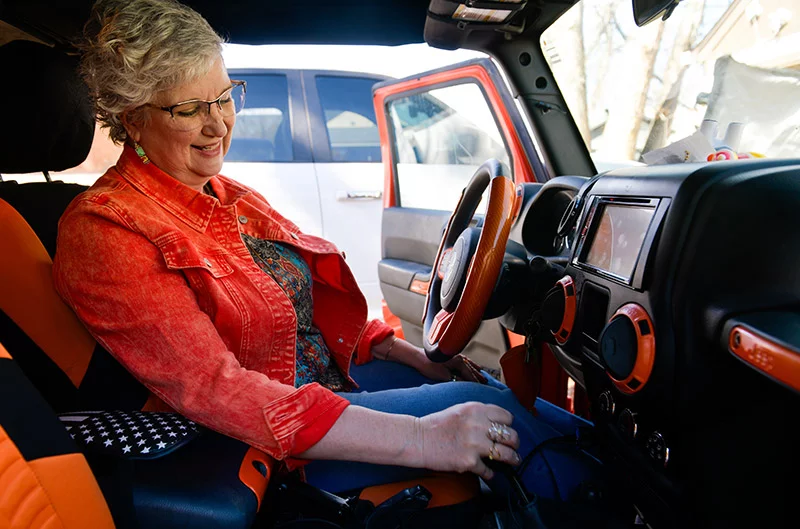
Given her thumb’s progress and a sunny day, Delgado to decided to take her e-bike out for the first time since the surgery. It’s got pedal-assist, but there’s also a half-twist throttle requiring gripping with the thumb and index finger of the right hand. This had been beyond her arthritic thumb’s capabilities. Delgado’s husband Ray had fashioned a workaround with duct tape and a thick hardware hairpin to let her control the bike’s motor with her index finger. Now she didn’t need the help, so Delgado carefully snipped it off.
“All of a sudden she wasn’t in pain,” Delgado said. “It kind of blows the mind.”
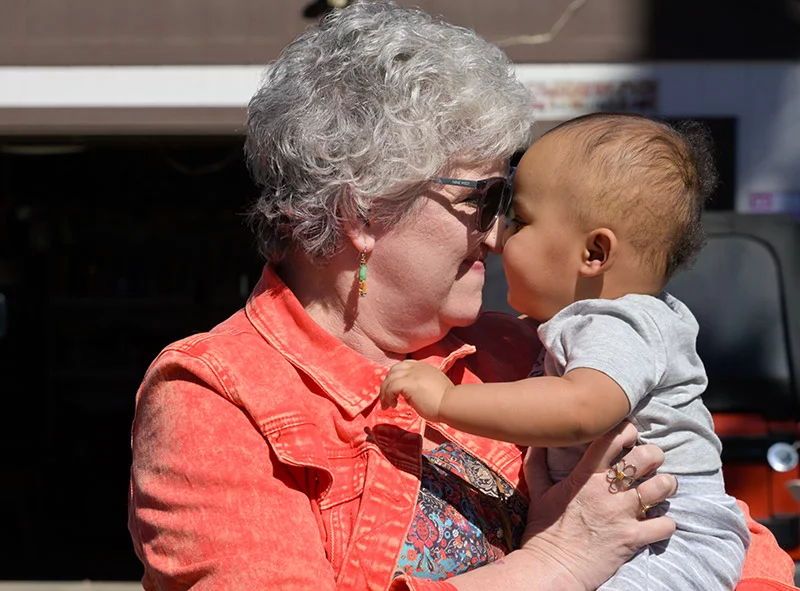
Delgado hooked up the bicycle trailer, and in went grandson Jermaine. With Maggie following on Ray’s e-bike, they headed toward the Lakewood Gulch Trail, all smiles.
Delgado described the Touch CMC 1 surgery as “a really pleasurable experience.” Now she’s hoping to experience it again: Her left thumb begs for surgery too.
Catalano and fellow hand surgeons and University of Colorado Anschutz School of Medicine professors Dr. Fraser Leversedge, Dr. Matthew Belton, and Dr. Mark Greyson have done about two dozen Touch CMC 1 surgeries since Delgado’s on Feb. 16, with more to come. These patients’ experiences have paralleled hers.
“All the patients are so happy so far,” Catalano said in an email. “Lot less pain and much quicker recovery (as we hoped!)”